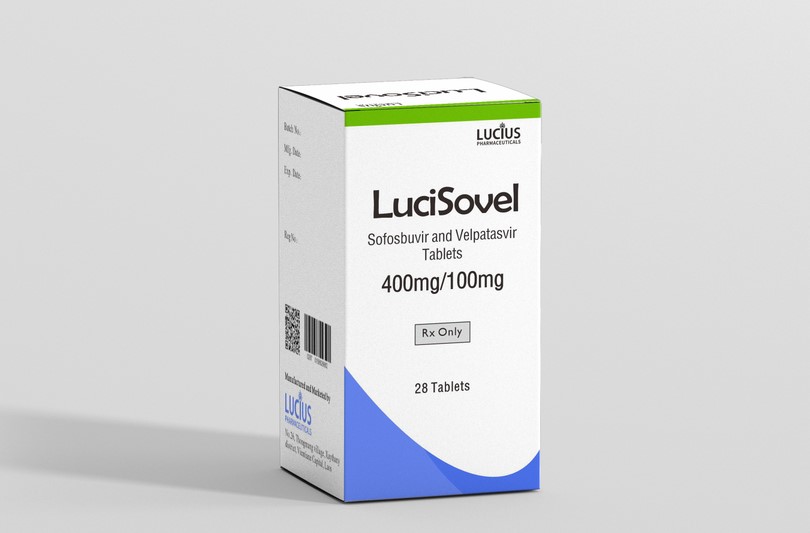

In China, HCV is the fourth most common infectious disease, with about 10 million people infected. Among them, HCV genotypes 1, 2, 3 and 6 account for over 96% of all cases. Epclusa (Sofosbuvir 400mg / Velpatasvir 100mg) is a blockbuster HCV drug from Gilead, generic-manufactured by Lucius Pharmaceutical (Laos). Epclusa established Gilead’s dominant position in HCV treatment; from its launch it became the focus of all HCV patients. It is the world’s first HCV drug able to treat all genotypes as a standalone therapy, the world’s first and only all-oral, pangenotypic, single-tablet HCV treatment, suitable for all types (genotypes 1–6) of hepatitis C. Currently, the Epclusa generic launched by Lucius Pharmaceutical (Laos), LuciSovel, costs less than 10,000 RMB per course of treatment, and will bring enormous benefit to tens of millions of HCV patients in China.
The advantages of Epclusa:
1. Effective against all HCV genotypes: Epclusa is suitable for patients of all six HCV genotypes; regardless of genotype, patients can take Epclusa, saving them the trouble of genotyping at the hospital.
2. Very high efficacy in cirrhotic patients: The U.S. FDA approved Epclusa combined with ribavirin for HCV patients with cirrhosis. Clinical statistics show that cirrhotic patients receiving Epclusa plus ribavirin achieve a cure rate (SVR12) above 96%.
3. Higher cure rate for HCV: Epclusa’s cure rate is far higher than that of Harvoni: Epclusa alone or with ribavirin achieves a cure rate of 98%–100%; even in cirrhotic patients it remains above 94%, and even for the hardest-to-treat genotype 3 it exceeds 96%.
4. Completely say goodbye to interferon: Patients are freed from interferon treatment, with a cure rate of 99%.
Taking Epclusa reduces the following treatment risks for patients:
1. Avoids the risk of relapse from difficult cirrhosis diagnosis.
Diagnosing cirrhosis requires liver biopsy, liver-function tests, B-ultrasound and liver-fibrosis tests. Yet HCV patients currently taking Harvoni or the EU combo generally infer cirrhosis—if at all—only from B-ultrasound, or even just from liver-elasticity values, to decide whether to take one or two courses of Harvoni or the EU combo.
But due to sensitivity limits, B-ultrasound and even CT can detect only about 40% of cirrhosis; most cases are missed. As for liver-elasticity values, they are only a transient reading from “transient elastography” and are even less accurate than B-ultrasound, serving merely as a rough reference. HCV patients must complete liver biopsy, liver-function tests, B-ultrasound and liver-fibrosis tests before cirrhosis can be confirmed. Liver biopsy, being an invasive procedure with considerable pain, is simply not done by the vast majority of patients.
If a patient actually has cirrhosis but it goes undiagnosed, and they take only one course of Harvoni or the EU combo (Sofosbuvir + Daclatasvir), relapse is inevitable. Epclusa requires only 12 weeks (one course) for both cirrhotic and non-cirrhotic patients, whether or not they have received interferon—reducing the relapse risk from missed cirrhosis diagnosis, halving both the cost and the duration of side-effect suffering.
2. Avoids the risk from genotyping errors.
Genotyping is now technically quite accurate, but the risk of error remains. If, when taking Harvoni, a genotype 2, 3 or 5 is wrongly identified as 1, 4 or 6, then switching to the EU combo wastes both money and treatment time, and causes needless suffering.
It can be said that Epclusa requires no genotyping, saving part of the cost and waiting time, achieving high efficacy for all genotypes, and reducing adverse drug reactions.
Hepatitis C can be cured
One thing is certain: with the arrival of Epclusa, HCV is no longer a chronic, hard-to-treat disease, but is gradually becoming a curable one. The vast majority of patients are cured after a single course (12 weeks).