

A lung-cancer drug of great importance to Chinese patients—Osimertinib
Summary:
· The third-generation EGFR targeted drug Osimertinib is superior to chemotherapy in every respect.
· Especially effective in Asian, non-smoking female patients.
· Also effective against brain metastases.
· Use must be accompanied by genetic sequencing.
(I)
Last month, warm applause rang out in Vienna, the city of music.
This time, it was not for music, but for science. At the World Conference on Lung Cancer held there, the first phase III clinical trial data for Osimertinib—the much-anticipated targeted lung-cancer drug—were announced, with inspiring results.
The name “Osimertinib” is unfamiliar to many, but it has a resounding nickname: AZD9291!
This drug was already well known to Chinese patients for years before its launch. The patients waiting to use Osimertinib are most numerous in China—by far.
Why?
Because it is the third-generation EGFR targeted drug that many Chinese patients need!
Let us first review the classification of lung cancer:
Lung cancer = non-small cell lung cancer (~85%) + small cell lung cancer (~15%)
Non-small cell lung cancer can be classified by two systems:
(By cell morphology) Non-small cell lung cancer = adenocarcinoma + squamous cell carcinoma + large cell carcinoma
(By gene mutation) Non-small cell lung cancer = EGFR mutation + ALK mutation + KRAS mutation …
Cell morphology and gene mutation are combined to give a more complete description, such as EGFR-mutant lung adenocarcinoma, KRAS-mutant lung squamous carcinoma, and so on.
Just as people have many classification systems: people = tall + short; people = rich + poor; people = handsome + plain. Combined, you get “tall-rich-handsome” or “short-plain-poor.”
Osimertinib is a third-generation EGFR targeted drug, which, as the name suggests, targets lung cancer patients with EGFR mutations.
Interestingly, EGFR mutations are found in less than 10% of European and American lung-cancer patients, but in nearly 30% of Chinese patients—and over 50% among lung adenocarcinomas! So I often joke that all EGFR targeted drugs, from the first to the third generation, seem custom-made by Western pharma for Chinese patients.
(II)
EGFR-mutant patients usually start with a first-generation EGFR targeted drug, such as Iressa (gefitinib), Tarceva (erlotinib) or the domestic Conmana (icotinib). Whichever it is, the initial effect is often good, but unfortunately, after about a year on average, most patients develop resistance. If the tumor progresses rapidly, the drug must be changed.
Resistance usually arises because the cancer cells change, and the change differs between patients. In 51%–63% of cases, the EGFR gene acquires a new mutation called T790M (also a type of EGFR mutation). This mutation prevents the first-generation drug from inhibiting the mutant protein, causing it to fail.
We often compare targeted drugs to keys and mutated genes to locks. After the T790M mutation occurs, the lock has changed, so the original key no longer works. (In the image below, the red is the targeted drug and the white is the mutated EGFR protein.)
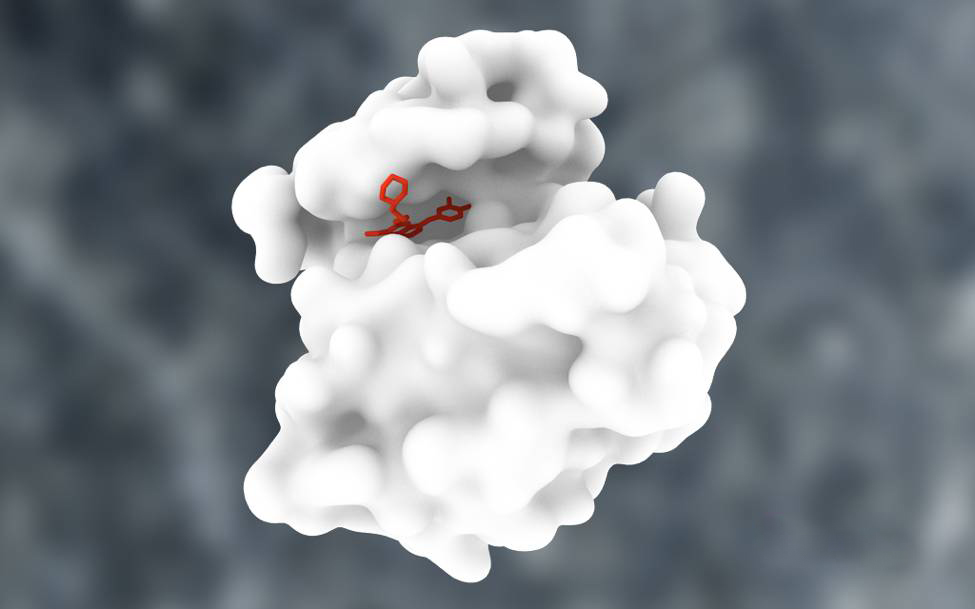
(Image courtesy of Dr. Jiang Hao, Bitcyte)
What to do about resistance? In the past, after resistance one could almost only switch to a combination chemotherapy regimen, but the arrival of the third-generation drug Osimertinib offers a better option for patients who became resistant due to the new T790M mutation.
What exactly is it good at? Look at the three rounds of “Osimertinib vs. chemotherapy” data released this time:
Round 1: median progression-free survival.
Osimertinib 10.1 months, chemotherapy 4.4 months. Osimertinib wins! 1:0!
Round 2: objective response rate.
Osimertinib 71%, chemotherapy 31%. Osimertinib wins! 2:0!
Round 3: significant side-effect rate.
Osimertinib 23%, chemotherapy 47%. Osimertinib wins! 3:0!
In a word, Osimertinib crushes chemotherapy across the board—better efficacy and fewer side effects. Therefore, it should be the first choice for T790M-resistant patients.
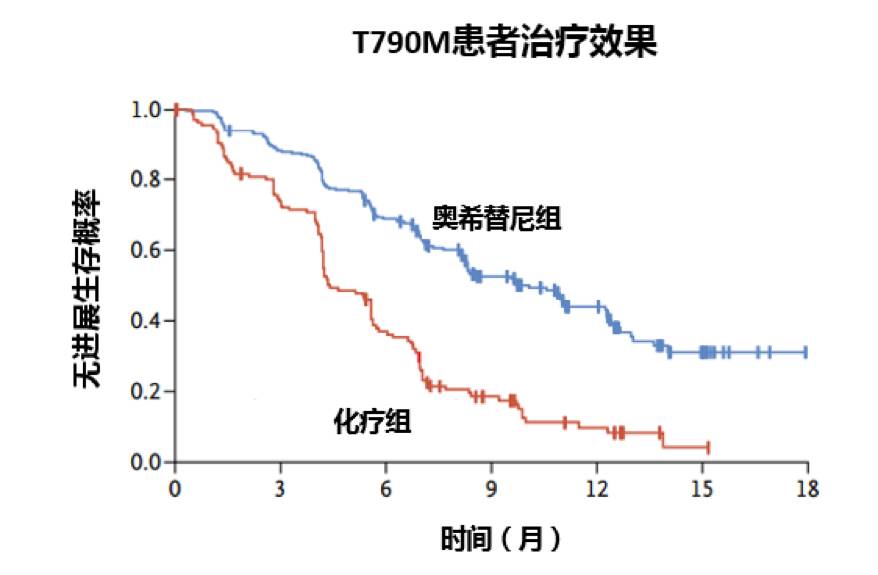
These data are for all T790M-mutant patients. If we subdivide further, some particularly interesting findings emerge:
Asian (including Chinese) patients benefit more than non-Asians!
Women benefit more than men!
Non-smokers benefit more than smokers!
What does this add up to?
It means that all T790M-mutant patients benefit from Osimertinib, but it is likely to help China’s large population of non-smoking female lung-cancer patients even more!
(III)
Osimertinib is a classic example of “precision medicine.”
Should everyone with first-generation EGFR resistance use Osimertinib?
No!
It is most effective against T790M-mutant patients, who make up the majority of resistant cases. But for resistance caused by other reasons—such as cMET or HER2 amplification—it works poorly, and may even be worse than chemotherapy, so I do not recommend blind trial.
To avoid wasting precious time and money, the first thing an EGFR-mutant lung-cancer patient must do when resistance appears is: perform genetic sequencing on the new tumor!
Be sure to sequence the post-resistance tumor, not the original one!
Because the tumor keeps changing during treatment. The tumor now may not be the tumor then.
Through genetic sequencing, if T790M is confirmed, Osimertinib should certainly be considered. If there is no T790M, other therapies may work better.
How is genetic testing done?
Simply put, there are two main approaches: one is to test a tumor-tissue (or pleural effusion) sample, the other is to test tumor DNA in the blood. The former is the gold standard; the latter is the rapidly developing “liquid biopsy.”
Currently, tissue (or pleural effusion) sequencing is still recommended. But if sampling is impossible for various reasons (e.g., bone or brain metastases), liquid biopsy may be considered.
This clinical trial showed that among patients positive on tissue testing, only about 50% were also positive on liquid biopsy. So if liquid biopsy is positive, Osimertinib may be considered; but if negative, one should not give up entirely, and may try tissue biopsy again to confirm whether T790M is truly present.
(IV)
One more point in this data release excited many doctors and patients:
Osimertinib is effective against brain metastases!
This is hugely important!
That is because over 50% of EGFR-mutant lung-cancer patients develop brain metastases—much higher than those without EGFR mutations. And most first-generation EGFR targeted drugs are blocked by the blood-brain barrier and cannot enter the brain. So once brain metastases occur, treatment effectiveness drops sharply, and patients’ quality of life and survival are greatly affected.
In the past, there was no good option for these patients, usually only radiotherapy.
From animal studies to early clinical data, everyone found that Osimertinib can cross the blood-brain barrier, so there was great anticipation that in large-scale trials it would show efficacy against brain metastases.
Fortunately, that is indeed the case!
Among the 419 patients in this trial, 144 had brain metastases. Median progression-free survival was 4.4 months in the chemotherapy arm, but extended to 8.5 months in the Osimertinib arm—almost the same as in patients without brain metastases. This had never been achieved by previous drugs.
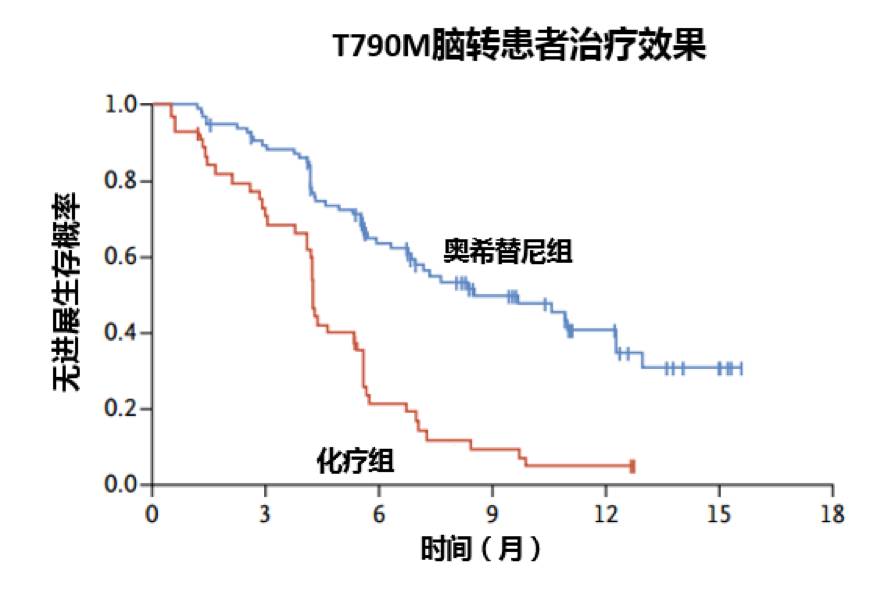
It is worth mentioning that Osimertinib can not only shrink brain metastases carrying the T790M resistance mutation, but is also effective against EGFR-mutant brain metastases that have not yet developed resistance. In another ongoing trial coded BLOOM, early results showed that among 20 EGFR-mutant (T790M-negative) leptomeningeal metastasis patients, at least 7 showed significant improvement.
This shows that if EGFR patients develop brain metastases, whether or not they have the T790M mutation, Osimertinib is likely a better choice than first-generation targeted drugs.
(V)
There is no doubt that Osimertinib’s data this time are excellent and will surely change the treatment paradigm for EGFR-mutant lung adenocarcinoma. Osimertinib is already approved in Europe, the U.S., Japan, Canada, South Korea, Hong Kong and elsewhere, and is under accelerated review in mainland China, hopefully reaching patients soon.
What is most anticipated now is the overall survival data, not yet released. Because it requires longer follow-up, it usually takes one or two more years. Shrinking the tumor is good, but truly and significantly extending patients’ overall survival is what truly earns the title of “miracle drug.”
Author of this article: Bolo (real name Li Zhizhong), B.S. in biological sciences from Tsinghua University, Ph.D. in cancer biology from Duke University; senior researcher in Novartis’s U.S. cancer drug discovery division; passionate about research, science communication and philanthropy; author of “Cancer Truth: A Book Doctors Also Read”; operator of the public account “Health Is No Joke”; founder of the charity platform “Sunflower Children’s Cancer”.