HIGHLIGHTS OF PRESCRIBING INFORMATION
These highlights do not include all the information needed to use LuciDabra safely and effectively. See full prescribing information for LuciDabra.
INDICATIONS AND USAGE
LuciDabra is a kinase inhibitor indicated as a single agent for the treatment of patients with unresectable or metastatic melanoma with BRAF V600E mutation as detected by an FDA-approved test.
LuciDabra is indicated, in combination with trametinib, for:
• the treatment of patients with unresectable or metastatic melanoma with BRAF V600E or V600K mutations as detected by an FDA-approved test.
• the adjuvant treatment of patients with melanoma with BRAF V600E or V600K mutations, as detected by an FDA-approved test, and involvement of lymph node(s), following complete resection.
• the treatment of patients with metastatic non-small cell lung cancer (NSCLC) with BRAF V600E mutation as detected by an FDA-approved test.
• the treatment of patients with locally advanced or metastatic anaplastic thyroid cancer (ATC) with BRAF V600E mutation and with no satisfactory locoregional treatment options.
• the treatment of adult and pediatric patients 1 year of age and older with unresectable or metastatic solid tumors with BRAF V600E mutation who have progressed following prior treatment and have no satisfactory alternative treatment options. This indication is approved under accelerated approval based on overall response rate (ORR) and duration of response (DoR). Continued approval for this indication may be contingent upon verification and description of clinical benefit in a confirmatory trial(s).
• the treatment of pediatric patients 1 year of age and older with low-grade glioma (LGG) with a BRAF V600E mutation who require systemic therapy.
DOSAGE AND ADMINISTRATION
The recommended dosage of LuciDabra in adult patients is 150 mg (two 75 mg capsules) orally twice daily. The recommended dosage for LuciDabra in pediatric patients is based on body weight. Take LuciDabra at least 1 hour before or at least 2 hours after a meal.
DOSAGE FORMS AND STRENGTHS
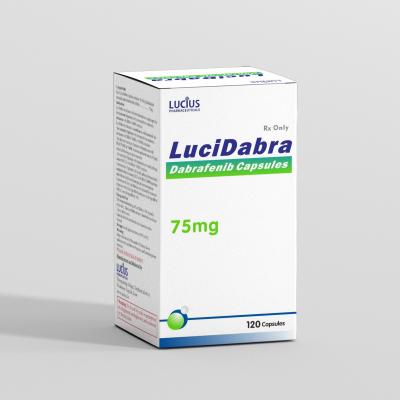
Capsules: 75 mg×120 capsules
CONTRAINDICATIONS
None.
WARNINGS AND PRECAUTIONS
• New Primary Malignancies, Cutaneous and Non-Cutaneous: Can occur when LuciDabra is administered as a single agent or with trametinib. Monitor patients for new malignancies prior to, or while on therapy, and following discontinuation of treatment.
• Tumor Promotion in BRAF Wild-type Tumors: Increased cell proliferation can occur with BRAF inhibitors.
• Hemorrhage: Major hemorrhagic events can occur in patients receiving LuciDabra with trametinib. Monitor for signs and symptoms of bleeding.
• Cardiomyopathy: Assess left ventricular ejection fraction (LVEF) before treatment with LuciDabra and trametinib, after one month of treatment, then every 2 to 3 months thereafter.
• Uveitis: Perform ophthalmological evaluation for any visual disturbances.
• Serious Febrile Reactions: Incidence and severity of pyrexia are increased with LuciDabra and trametinib.
• Serious Skin Toxicities: Monitor for skin toxicities. Discontinue for intolerable Grade 2 or for Grade 3 or 4 rash not improving within 3 weeks despite interruption of LuciDabra. Permanently discontinue for severe cutaneous adverse reactions (SCARs).
• Hyperglycemia: Monitor serum glucose levels in patients with preexisting diabetes or hyperglycemia.
• Glucose-6-phosphate Dehydrogenase Deficiency (G6PD): Closely monitor for hemolytic anemia.
• Hemophagocytic Lymphohistiocytosis (HLH): Interrupt treatment for suspected HLH. Discontinue treatment if HLH is confirmed.
• Embryo-Fetal Toxicity: Can cause fetal harm. Advise females of reproductive potential of potential risk to a fetus and to use an effective non-hormonal method of contraception.
ADVERSE REACTIONS
Most common adverse reactions (≥ 20%) for LuciDabra as a single agent are hyperkeratosis, headache, pyrexia, arthralgia, papilloma, alopecia, and palmar-plantar erythrodysesthesia syndrome.
Most common adverse reactions (≥ 20%) for LuciDabra in combination with trametinib include:
• Unresectable or metastatic melanoma: pyrexia, rash, chills, headache, arthralgia, and cough.
• Adjuvant treatment of melanoma: pyrexia, fatigue, nausea, headache, rash, chills, diarrhea, vomiting, arthralgia, and myalgia.
• NSCLC: pyrexia, fatigue, nausea, vomiting, diarrhea, dry skin, decreased appetite, edema, rash, chills, hemorrhage, cough, and dyspnea.
• Adult patients with solid tumors: pyrexia, fatigue, nausea, rash, chills, headache, hemorrhage, cough, vomiting, constipation, diarrhea, myalgia, arthralgia, and edema.
• Pediatric patients with solid tumors: pyrexia, rash, vomiting, fatigue, dry skin, cough, diarrhea, dermatitis acneiform, headache, abdominal pain, nausea, hemorrhage, constipation, and paronychia.
• Pediatric patients with LGG: pyrexia, rash, headache, vomiting, musculoskeletal pain, fatigue, diarrhea, dry skin, nausea, hemorrhage, abdominal pain, and dermatitis acneiform.
DRUG INTERACTIONS
• Avoid concurrent administration of strong inhibitors of CYP3A4 or CYP2C8.
• Concomitant use with agents that are sensitive substrates of CYP3A4, CYP2C8, CYP2C9, CYP2C19, or CYP2B6 may result in loss of efficacy of these agents.
USE IN SPECIFIC POPULATIONS
• Lactation: Do not breastfeed.
• Females and Males of Reproductive Potential: May impair fertility.
Storage
Store at 20℃ to 25℃ (68℉ to 77℉), excursions permitted between 15℃ and 30℃ (59℉ and 86℉) [see USP Controlled Room Temperature]. Protect from moisture.
 WeChat
 WhatsApp