HIGHLIGHTS OF PRESCRIBING INFORMATION
These highlights do not include all the information needed to use LUCIOLAP safely and effectively. See full prescribing information for LUCIOLAP.
INDICATIONS AND USAGE
LUCIOLAP is a poly (ADP-ribose) polymerase (PARP) inhibitor indicated:
Ovarian cancer
• for the maintenance treatment of adult patients with deleterious or suspected deleterious germline or somatic BRCA-mutated advanced epithelial ovarian, fallopian tube or primary peritoneal cancer who are in complete or partial response to first-line platinum-based chemotherapy. Select patients for therapy based on an FDA-approved companion diagnostic for LUCIOLAP.
• in combination with bevacizumab for the maintenance treatment of adult patients with advanced epithelial ovarian, fallopian tube or primary peritoneal cancer who are in complete or partial response to first-line platinum-based chemotherapy and whose cancer is associated with homologous recombination deficiency (HRD)-positive status defined by either:
• a deleterious or suspected deleterious BRCA mutation, and/or
• genomic instability.
Select patients for therapy based on an FDA-approved companion diagnostic for LUCIOLAP.
• for the maintenance treatment of adult patients with deleterious or suspected deleterious germline or somatic BRCA-mutated recurrent epithelial ovarian, fallopian tube or primary peritoneal cancer, who are in complete or partial response to platinum-based chemotherapy. Select patients for therapy based on an FDA-approved companion diagnostic for LUCIOLAP.
Breast cancer
• for the adjuvant treatment of adult patients with deleterious or suspected deleterious gBRCAm human epidermal growth factor receptor 2 (HER2)-negative high risk early breast cancer who have been treated with neoadjuvant or adjuvant chemotherapy. Select patients for therapy based on an FDA-approved companion diagnostic for LUCIOLAP.
• for the treatment of adult patients with deleterious or suspected deleterious gBRCAm, HER2-negative metastatic breast cancer who have been treated with chemotherapy in the neoadjuvant, adjuvant or metastatic setting. Patients with hormone receptor (HR)-positive breast cancer should have been treated with a prior endocrine therapy or be considered inappropriate for endocrine therapy. Select patients for therapy based on an FDA-approved companion diagnostic for LUCIOLAP.
Pancreatic cancer
• for the maintenance treatment of adult patients with deleterious or suspected deleterious gBRCAm metastatic pancreatic adenocarcinoma whose disease has not progressed on at least 16 weeks of a first-line platinum-based chemotherapy regimen. Select patients for therapy based on an FDA-approved companion diagnostic for LUCIOLAP.
Prostate cancer
• for the treatment of adult patients with deleterious or suspected deleterious germline or somatic homologous recombination repair (HRR) gene-mutated metastatic castration-resistant prostate cancer (mCRPC) who have progressed following prior treatment with enzalutamide or abiraterone. Select patients for therapy based on an FDA-approved companion diagnostic for LUCIOLAP.
• in combination with abiraterone and prednisone or prednisolone for the treatment of adult patients with deleterious or suspected deleterious BRCA-mutated (BRCAm) metastatic castration-resistant prostate cancer (mCRPC). Select patients for therapy based on an FDA-approved companion diagnostic for LUCIOLAP.
DOSAGE AND ADMINISTRATION
• Recommended dosage is 300 mg taken orally twice daily with or without food. See Full Prescribing Information for the recommended duration.
• Patients receiving LUCIOLAP for mCRPC should also receive a gonadotropin-releasing hormone (GnRH) analog concurrently or should have had bilateral orchiectomy.
• For moderate renal impairment (CLcr 31-50 mL/min), reduce LUCIOLAP dosage to 200 mg orally twice daily.
DOSAGE FORMS AND STRENGTHS
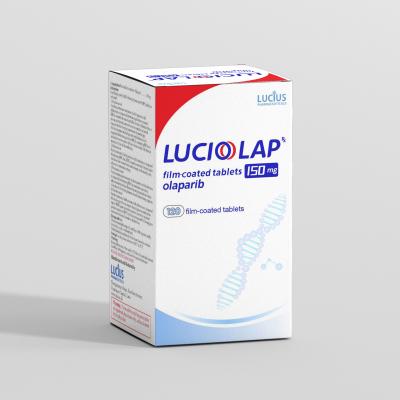
Tablets: 150 mg×120 tablets
CONTRAINDICATIONS
None.
WARNINGS AND PRECAUTIONS
• Myelodysplastic Syndrome/Acute Myeloid Leukemia (MDS/AML): Occurred in approximately 1.2% of patients with various BRCAm, gBRCAm, HRR gene-mutated or HRD-positive cancers exposed to LUCIOLAP and the majority of events had a fatal outcome. Monitor patients for hematological toxicity at baseline and monthly thereafter. Discontinue if MDS/AML is confirmed.
• Pneumonitis: Occurred in 0.8% of patients exposed to LUCIOLAP, and some cases were fatal. Interrupt treatment if pneumonitis is suspected. Discontinue if pneumonitis is confirmed.
• Venous thromboembolism (VTE), including severe or fatal pulmonary embolism (PE), occurred in patients treated with LUCIOLAP. VTE occurred in 8% of patients with mCRPC. Monitor patients for signs and symptoms of VTE and PE and treat as medically appropriate.
• Embryo-Fetal Toxicity: Can cause fetal harm. Advise of the potential risk to a fetus and to use effective contraception.
ADVERSE REACTIONS
Most common adverse reactions (≥10%) in clinical trials:
• as a single agent were nausea, fatigue (including asthenia), anemia, vomiting, diarrhea, decreased appetite, headache, dysgeusia, cough, neutropenia, dyspnea, dizziness, dyspepsia, leukopenia, and thrombocytopenia.
• in combination with bevacizumab were nausea, fatigue (including asthenia), anemia, lymphopenia, vomiting, diarrhea, neutropenia, leukopenia, urinary tract infection, and headache.
• in combination with abiraterone and prednisone or prednisolone were anemia, fatigue, nausea, diarrhea, decreased appetite, lymphopenia, dizziness, and abdominal pain.
DRUG INTERACTIONS
• Strong or moderate CYP3A inhibitors: Avoid concomitant use. If concomitant use cannot be avoided, reduce LUCIOLAP dosage.
• Strong or moderate CYP3A inducers: Avoid concomitant use.
USE IN SPECIFIC POPULATIONS
Lactation: Advise women not to breastfeed.
Storage
Store at 20℃ to 25℃ (68℉ to 77℉), excursions permitted between 15℃ and 30℃ (59℉ and 86℉) [see USP Controlled Room Temperature]. Protect from moisture.
 WeChat
 WhatsApp