HIGHLIGHTS OF PRESCRIBING INFORMATION
These highlights do not include all the information needed to use LuciPral safely and effectively. See full prescribing information for LuciPral.
INDICATIONS AND USAGE
LuciPral is a kinase inhibitor indicated for treatment of:
• Adult patients with metastatic rearranged during transfection (RET) fusion-positive non-small cell lung cancer as detected by an FDA approved test (NSCLC).
• Adult and pediatric patients 12 years of age and older with advanced or metastatic RET-mutant medullary thyroid cancer (MTC) who require systemic therapy.
• Adult and pediatric patients 12 years of age and older with advanced or metastatic RET fusion-positive thyroid cancer who require systemic therapy and who are radioactive iodine-refractory (if radioactive iodine is appropriate).
This indication is approved under accelerated approval based on overall response rate and duration of response. Continued approval for this indication may be contingent upon verification and description of clinical benefit in confirmatory trial(s).
DOSAGE AND ADMINISTRATION
Select patients for treatment with LuciPral based on the presence of a RET gene fusion or gene mutation.
The recommended dosage in adults and pediatric patients 12 years and older is 400 mg orally once daily on an empty stomach (no food intake for at least 2 hours before and at least 1 hour after taking LuciPral).
DOSAGE FORMS AND STRENGTHS
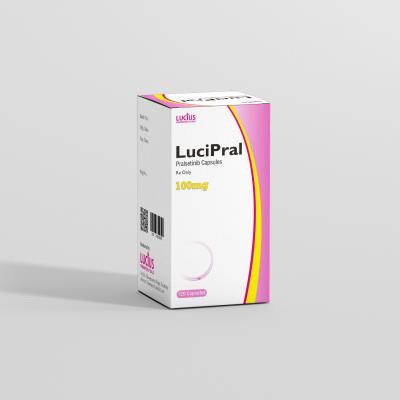
Capsules: 100mg×120 capsules
CONTRAINDICATIONS
None.
WARNINGS AND PRECAUTIONS
• Interstitial Lung Disease (ILD)/Pneumonitis: Withhold LuciPral for Grade 1 or 2 reactions until resolution and then resume at a reduced dose. Permanently discontinue for recurrent ILD/pneumonitis. Permanently discontinue for Grade 3 or 4 reactions.
• Hypertension: Do not initiate LuciPral in patients with uncontrolled hypertension. Optimize blood pressure (BP) prior to initiating LuciPral. Monitor BP after 1 week, at least monthly thereafter and as clinically indicated. Withhold, reduce dose, or permanently discontinue LuciPral based on severity.
• Hepatotoxicity: Monitor ALT and AST prior to initiating LuciPral, every 2 weeks during the first 3 months, then monthly thereafter and as clinically indicated. Withhold, reduce dose, or permanently discontinue LuciPral based on severity.
• Hemorrhagic Events: Permanently discontinue LuciPral in patients with severe or life-threatening hemorrhage.
• Tumor Lysis Syndrome: Closely monitor patients at risk and treat as clinically indicated.
• Risk of Impaired Wound Healing: Withhold LuciPral for at least 5 days prior to elective surgery. Do not administer for at least 2 weeks following major surgery and until adequate wound healing. The safety of resumption of LuciPral after resolution of wound healing complications has not been established.
• Embryo-Fetal Toxicity: Can cause fetal harm. Advise females of reproductive potential of the potential risk to a fetus and to use effective non-hormonal contraception.
ADVERSE REACTIONS
The most common adverse reactions (≥25%) were constipation, hypertension, fatigue, musculoskeletal pain and diarrhea. The most common Grade 3-4 laboratory abnormalities (≥2%) were decreased lymphocytes, decreased neutrophils, decreased hemoglobin, decreased phosphate, decreased calcium (corrected), decreased sodium, increased aspartate aminotransferase (AST), increased alanine aminotransferase (ALT), decreased platelets, and increased alkaline phosphatase.
DRUG INTERACTIONS
• Strong CYP3A inhibitors: Avoid coadministration.
• Combined P-gp and Strong CYP3A inhibitors: Avoid coadministration. If coadministration cannot be avoided, reduce the dose of LuciPral.
• Strong CYP3A inducers: Avoid coadministration. If coadministration cannot be avoided, increase the dose of LuciPral.
USE IN SPECIFIC POPULATIONS
• Lactation: Advise not to breastfeed. (8.2)
• Pediatric Use: Monitor open growth plates in adolescent patients.
Consider interrupting or discontinuing LuciPral if abnormalities occur.
Storage
Store at 20℃ to 25℃ (68℉ to 77℉), excursions permitted between 15℃ and 30℃ (59℉ and 86℉) [see USP Controlled Room Temperature]. Protect from moisture.
 WeChat
 WhatsApp