HIGHLIGHTS OF PRESCRIBING INFORMATION
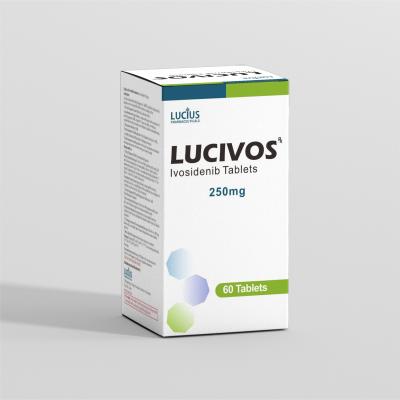
These highlights do not include all the information needed to use LUCIVOS safely and effectively. See full prescribing information for LUCIVOS.
INDICATIONS AND USAGE
LUCIVOS is an isocitrate dehydrogenase-1 (IDH1) inhibitor indicated for patients with a susceptible IDH1 mutation as detected by an FDA-approved test with:
Newly Diagnosed Acute Myeloid Leukemia (AML)
• In combination with azacitidine or as monotherapy for the treatment of newly diagnosed AML in adults 75 years or older, or who have comorbidities that preclude use of intensive induction chemotherapy.
Relapsed or refractory AML
• For the treatment of adult patients with relapsed or refractory AML.
Locally Advanced or Metastatic Cholangiocarcinoma
• For the treatment of adult patients with locally advanced or metastatic cholangiocarcinoma who have been previously treated .
DOSAGE AND ADMINISTRATION
500 mg orally once daily with or without food until disease progression or unacceptable toxicity. Avoid a high-fat meal.
DOSAGE FORMS AND STRENGTHS
Tablets: 250 mg×60 tablets
CONTRAINDICATIONS
None.
WARNINGS AND PRECAUTIONS
• QTc Interval Prolongation: Monitor electrocardiograms and electrolytes. If QTc interval prolongation occurs, dose reduce or withhold, then resume dose or permanently discontinue LUCIVOS.
• Guillain-Barré Syndrome: Monitor patients for signs and symptoms of new motor and/or sensory findings. Permanently discontinue LUCIVOS in patients who are diagnosed with Guillain-Barré syndrome.
ADVERSE REACTIONS
The most common adverse reactions including laboratory abnormalities (≥25%) in patients with AML are leukocytes decreased, diarrhea, hemoglobin decreased, platelets decreased, glucose increased, fatigue, alkaline phosphatase increased, edema, potassium decreased, nausea, vomiting, phosphate decreased, decreased appetite, sodium decreased, leukocytosis, magnesium decreased, aspartate aminotransferase increased, arthralgia, dyspnea, uric acid increased, abdominal pain, creatinine increased, mucositis, rash, electrocardiogram QT prolonged, differentiation syndrome, calcium decreased, neutrophils decreased, and myalgia.
The most common adverse reactions (≥15%) in patients with cholangiocarcinoma are fatigue, nausea, abdominal pain, diarrhea, cough, decreased appetite, ascites, vomiting, anemia, and rash.
The most common laboratory abnormalities (≥10%) in patients with cholangiocarcinoma are hemoglobin decreased, aspartate aminotransferase increased, and bilirubin increased.
DRUG INTERACTIONS
• Strong or Moderate CYP3A4 Inhibitors: Reduce LUCIVOS dose with strong CYP3A4 inhibitors. Monitor patients for increased risk of QTc interval prolongation.
• Strong CYP3A4 Inducers: Avoid concomitant use with LUCIVOS.
• Sensitive CYP3A4 substrates: Avoid concomitant use with LUCIVOS.
• QTc Prolonging Drugs: Avoid concomitant use with LUCIVOS. If co-administration is unavoidable, monitor patients for increased risk of QTc interval prolongation.
USE IN SPECIFIC POPULATIONS
Lactation: Advise women not to breastfeed.
Storage
Store at 20℃ to 25℃ (68℉ to 77℉), excursions permitted between 15℃ and 30℃ (59℉ and 86℉) [see USP Controlled Room Temperature]. Protect from moisture.
 WeChat
 WhatsApp