HIGHLIGHTS OF PRESCRIBING INFORMATION
These highlights do not include all the information needed to use LuciAsc safely and effectively. See full prescribing information for LuciAsc.
INDICATIONS AND USAGE
LuciAsc is a kinase inhibitor indicated for the treatment of adult patients with:
• Philadelphia chromosome-positive chronic myeloid leukemia (Ph+ CML) in chronic phase (CP), previously treated with two or more tyrosine kinase inhibitors (TKIs).
• Ph+ CML in CP with the T315I mutation.
DOSAGE AND ADMINISTRATION
•Recommended Dosage in Ph+ CML in CP: 80 mg orally once daily or 40 mg orally twice daily.
• Recommended Dosage in Ph+ CML in CP with the T315I Mutation: 200 mg orally twice daily.
• Avoid food for at least 2 hours before and 1 hour after taking LuciAsc.
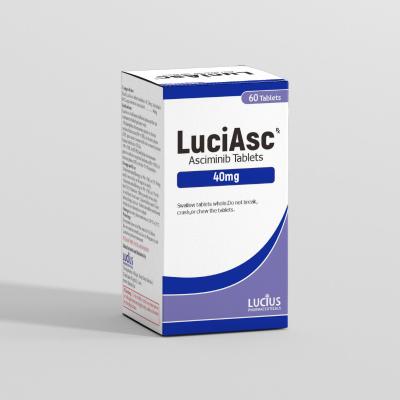
•Swallow tablets whole. Do not break, crush, or chew the tablets.
DOSAGE FORMS AND STRENGTHS
Tablets: 40 mg×60 tablets
CONTRAINDICATIONS
None.
WARNINGS AND PRECAUTIONS
•Myelosuppression: Severe thrombocytopenia and neutropenia events may occur. Monitor complete blood counts regularly during therapy and manage by treatment interruption or dose reduction.
• Pancreatic Toxicity: Monitor serum lipase and amylase. Interrupt, then resume at reduced dose or discontinue LuciAsc based on severity. Evaluate for pancreatitis when lipase elevation is accompanied by abdominal symptoms.
• Hypertension: Monitor blood pressure and manage hypertension as clinically indicated. Interrupt, dose reduce, or stop LuciAsc if hypertension is not medically controlled.
• Hypersensitivity: May cause hypersensitivity reactions. Monitor patients for signs and symptoms and initiate appropriate treatment as clinically indicated.
• Cardiovascular Toxicity: Cardiovascular toxicity may occur. Monitor patients with history of cardiovascular risk factors for cardiovascular signs and symptoms. Initiate appropriate treatment as clinically indicated.
• Embryo-Fetal Toxicity: Can cause fetal harm. Advise females of reproductive potential of the potential risk to a fetus and to use effective contraception.
ADVERSE REACTIONS
Most common adverse reactions (≥ 20%) are upper respiratory tract infections, musculoskeletal pain, headache, fatigue, nausea, rash, and diarrhea.
Most common laboratory abnormalities (≥ 20%) are platelet count decreased, triglycerides increased, neutrophil count decreased, hemoglobin decreased, creatine kinase increased, alanine aminotransferase (ALT) increased, lipase increased, amylase increased, aspartate aminotransferase (AST) increased, uric acid increased, and lymphocyte count decreased.
DRUG INTERACTIONS
• Strong CYP3A4 Inhibitors: Closely monitor for adverse reactions during concomitant use of LuciAsc at 200 mg twice daily.
• Itraconazole Oral Solution Containing Hydroxypropyl-β-cyclodextrin: Avoid concomitant use of LuciAsc at all recommended doses.
• Certain Substrates of CYP3A4: Closely monitor for adverse reactions during concomitant use of LuciAsc at 80 mg total daily dose. Avoid use of LuciAsc at 200 mg twice daily.
• Substrates of CYP2C9: Avoid concomitant use of LuciAsc at all recommended doses.
o 80 mg total daily dose: If unavoidable, reduce the CYP2C9 substrate dosage as necessary.
o 200 mg twice daily: If unavoidable, consider alternative therapy with non-CYP2C9 substrate.
• Certain P-gp Substrates: Closely monitor for adverse reactions during concomitant use of LuciAsc at all recommended doses.
• Substrates of OATP1B or BCRP: Avoid concomitant use with rosuvastatin and atorvastatin at all recommended doses. Closely monitor for adverse reactions of other OATP1B or BCRP substrates during concomitant use of LuciAsc at all recommended doses.
USE IN SPECIFIC POPULATIONS
Lactation: Advise not to breastfeed.
Storage
Store at 20℃ to 25℃ (68℉ to 77℉), excursions permitted between 15℃ and 30℃ (59℉ and 86℉) [see USP Controlled Room Temperature]. Protect from moisture.
 WeChat
 WhatsApp