HIGHLIGHTS OF PRESCRIBING INFORMATION
These highlights do not include all the information needed to use LuciRit safely and effectively. See full prescribing information for LuciRit.
INDICATIONS AND USAGE
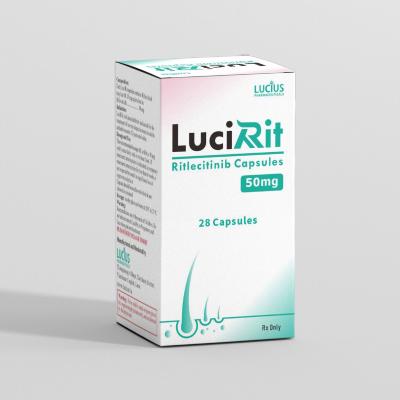
LuciRit is a kinase inhibitor indicated for the treatment of severe alopecia areata in adults and adolescents 12 years and older.
Limitations of Use: Not recommended for use in combination with other JAK inhibitors, biologic immunomodulators, cyclosporine or other potent immunosuppressants.
DOSAGE AND ADMINISTRATION
• For recommended testing, evaluations and immunizations prior to LuciRit initiation, see Full Prescribing Information.
• Recommended dosage is 50 mg orally once daily.
• For dosage interruption for certain adverse reactions, see Full Prescribing Information.
DOSAGE FORMS AND STRENGTHS
Capsules: 50 mg×28 capsules
CONTRAINDICATIONS
LuciRit is contraindicated in patients with known hypersensitivity to ritlecitinib or any of its excipients.
WARNINGS AND PRECAUTIONS
• Hypersensitivity: Discontinue LuciRit if a clinically significant hypersensitivity reaction occurs.
• Laboratory Abnormalities: Perform ALC and platelet counts prior to LuciRit initiation. Treatment interruption or discontinuation are recommended based on ALC and platelet count abnormalities.
• Vaccinations: Avoid use of live vaccines during or shortly prior to LuciRit treatment.
ADVERSE REACTIONS
Most common adverse reactions (incidence ≥1%) are headache, diarrhea, acne, rash, urticaria, folliculitis, pyrexia, atopic dermatitis, dizziness, blood creatine phosphokinase increased, herpes zoster, red blood cell count decreased, and stomatitis.
DRUG INTERACTIONS
• Certain CYP3A substrates: Additional monitoring and dose adjustment of CYP3A substrate should be considered.
• Certain CYP1A2 substrates: Additional monitoring and dose adjustment of CYP1A2 substrate should be considered.
• Certain CYP3A inducers: Coadministration with strong inducers of CYP3A is not recommended.
USE IN SPECIFIC POPULATIONS
• Lactation: Breastfeeding not recommended.
• Severe Hepatic Impairment: Not recommended.
Storage
Store at 20℃ to 25℃ (68℉ to 77℉), excursions permitted between 15℃ and 30℃ (59℉ and 86℉) [see USP Controlled Room Temperature]. Protect from moisture.
 WeChat
 WhatsApp