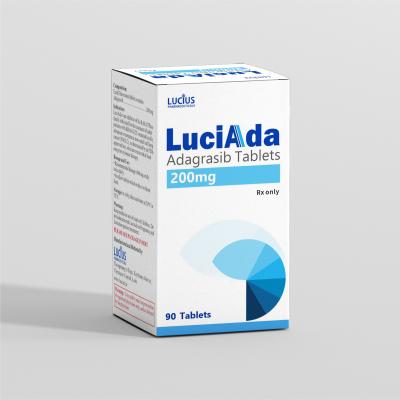
HIGHLIGHTS OF PRESCRIBING INFORMATION
These highlights do not include all the information needed to use LuciAda safely and effectively. See full prescribing information for LuciAda.
INDICATIONS AND USAGE
LuciAda is an inhibitor of the RAS GTPase family indicated for the treatment of adult patients with KRAS G12C-mutated locally advanced or metastatic non-small cell lung cancer (NSCLC), as determined by an FDA approved test, who have received at least one prior systemic therapy.
This indication is approved under accelerated approval based on objective response rate (ORR) and duration of response (DOR). Continued approval for this indication may be contingent upon verification and description of a clinical benefit in a confirmatory trial(s).
DOSAGE AND ADMINISTRATION
• Recommended dosage: 600 mg orally twice daily.
• Swallow tablets whole with or without food.
DOSAGE FORMS AND STRENGTHS
Tablets: 200 mg×90 tablets
CONTRAINDICATIONS
None.
WARNINGS AND PRECAUTIONS
• Gastrointestinal Adverse Reactions: Monitor patients for diarrhea, nausea and vomiting and provide supportive care as needed. Withhold, reduce the dose or permanently discontinue based on severity.
• QTc Interval Prolongation: Avoid concomitant use of LuciAda with other products with a known potential to prolong the QTc interval. Monitor ECG and electrolytes in patients at risk, and in patients taking medications known to prolong the QT interval. Withhold, reduce the dose, or permanently discontinue based on severity.
• Hepatotoxicity: Monitor liver laboratory tests prior to the start of LuciAda and monthly for 3 months after and as clinically indicated. Reduce the dose, withhold, or permanently discontinue based on severity.
• Interstitial Lung Disease / Pneumonitis: Monitor for new or worsening respiratory symptoms. Withhold LuciAda for suspected ILD/pneumonitis and permanently discontinue if no other potential causes of ILD/pneumonitis are identified.
ADVERSE REACTIONS
• The most common (≥ 25%) adverse reactions were nausea, diarrhea, vomiting, fatigue, musculoskeletal pain, hepatotoxicity, renal impairment, edema, dyspnea, and decreased appetite.
• The most common Grade 3 or 4 (≥ 2%) laboratory abnormalities were decreased lymphocytes, decreased hemoglobin, increased alanine aminotransferase, increased aspartate aminotransferase, hypokalemia, hyponatremia, increased lipase, decreased leukocytes, decreased neutrophils and increased alkaline phosphatase.
DRUG INTERACTIONS
See full prescribing information for clinically significant drug interactions with LuciAda.
• Strong CYP3A4 Inducers: Avoid concomitant use.
• Strong CYP3A4 Inhibitors: Avoid concomitant use until adagrasib concentrations have reached steady state.
• Sensitive CYP3A4 Substrates: Avoid concomitant use with sensitive CYP3A4 substrates.
• Sensitive CYP2C9 or CYP2D6 Substrates or P-gp Substrates: Avoid concomitant use with sensitive CYP2C9 or CYP2D6 substrates or P-gp substrates where minimal concentration changes may lead to serious adverse reactions.
• Drugs That Prolong QT Interval: Avoid concomitant use with LuciAda.
USE IN SPECIFIC POPULATIONS
Lactation: Advise not to breastfeed.
Storage
Store at 20℃ to 25℃ (68℉ to 77℉), excursions permitted between 15℃ and 30℃ (59℉ and 86℉) [see USP Controlled Room Temperature]. Protect from moisture.
 WeChat
 WhatsApp