HIGHLIGHTS OF PRESCRIBING INFORMATION
These highlights do not include all the information needed to use LuciPona safely and effectively. See full prescribing information for LuciPona.
INDICATIONS AND USAGE
LuciPona is a kinase inhibitor indicated for the treatment of adult patients with:
· Chronic phase (CP) chronic myeloid leukemia (CML) with resistance or intolerance to at least two prior kinase inhibitors.
· Accelerated phase (AP) or blast phase (BP) CML or Philadelphia chromosome positive acute lymphoblastic leukemia (Ph+ ALL) for whom no other kinase inhibitors are indicated.
· T315I-positive CML (chronic phase, accelerated phase, or blast phase) or T315I-positive Ph+ ALL.
Limitations of Use: LuciPona is not indicated and is not recommended for the treatment of patients with newly diagnosed CP-CML.
DOSAGE AND ADMINISTRATION
• Recommended Dosage in CP-CML: Starting dose is 45 mg orally once daily with a reduction to 15 mg once daily upon achievement of ≤1% BCR-ABL1IS.
• Recommended Dosage in AP-CML, BP-CML, and Ph+ ALL: Starting dose is 45 mg orally once daily.
• Hepatic Impairment: Reduce the starting dose to 30 mg orally once daily.
• LuciPona may be taken with or without food.
DOSAGE FORMS AND STRENGTHS
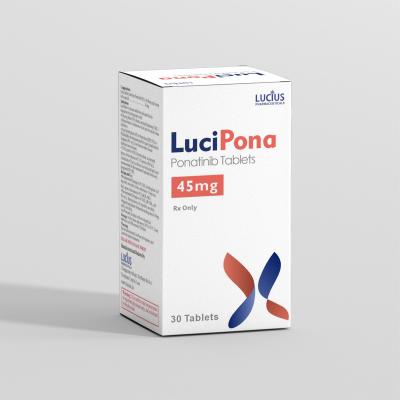
Tablets: 45 mg×30 tablets
CONTRAINDICATIONS
None.
WARNINGS AND PRECAUTIONS
• Hypertension: Monitor blood pressure and manage hypertension as clinically indicated. Interrupt, dose reduce or stop LuciPona if hypertension is not medically controlled.
• Pancreatitis: Monitor serum lipase. Interrupt, then resume at the same or reduced dose or discontinue LuciPona based on severity. Evaluate for pancreatitis when lipase elevation is accompanied by abdominal symptoms.
• Neuropathy: Monitor for symptoms of peripheral and cranial neuropathy. Interrupt, then resume at the same or reduced dose or discontinue LuciPona based on recurrence/severity.
• Ocular Toxicity: Conduct comprehensive eye exams at baseline and periodically during treatment.
• Hemorrhage: Monitor for hemorrhage and manage patients as clinically indicated. Interrupt, then resume at the same or reduced dose or discontinue LuciPona based on recurrence/severity.
• Fluid Retention: Monitor for fluid retention and manage patients as clinically indicated. Interrupt, then resume at the same or reduced dose or discontinue LuciPona based on recurrence/severity.
• Cardiac Arrhythmias: Monitor for signs or symptoms of arrhythmias and manage patients as clinically indicated. Interrupt, then resume at the same or reduced dose or discontinue LuciPona based on recurrence/severity.
• Myelosuppression: Obtain complete blood counts every 2 weeks for the first 3 months and then monthly or as clinically indicated. If ANC less than 1 x 10⁹/L or platelets less than 50 x 109/L, interrupt LuciPona until ANC at least 1.5 x 10⁹/L and platelets at least 75 x 109/L, then resume at same or reduced dose.
• Tumor Lysis Syndrome: Ensure adequate hydration and correct elevated uric acid levels prior to initiating LuciPona.
• Reversible Posterior Leukoencephalopathy Syndrome (RPLS): Interrupt LuciPona until resolution. The safety of resumption of LuciPona in patients upon resolution of RPLS is unknown.
• Impaired Wound Healing and Gastrointestinal Perforation: Withhold LuciPona for at least 1 week prior to elective surgery. Do not administer for at least 2 weeks following major surgery and until adequate wound healing. The safety of resumption of LuciPona after resolution of wound healing complications has not been established.
• Embryo-Fetal Toxicity: Can cause fetal harm. Advise females of reproductive potential of the potential risk to a fetus and to use effective contraception.
ADVERSE REACTIONS
The most common (>20%) adverse reactions are rash and related conditions, arthralgia, abdominal pain, headache, constipation, dry skin, hypertension, fatigue, fluid retention and edema, pyrexia, nausea, pancreatitis/lipase elevation, hemorrhage, anemia, hepatic dysfunction and AOEs. The most common Grade 3 or 4 laboratory abnormalities (>20%) are platelet count decreased, neutrophil cell count decreased, and white blood cell decreased.
DRUG INTERACTIONS
• Strong CYP3A Inhibitors: Avoid coadministration or reduce LuciPona dose if coadministration cannot be avoided.
• Strong CYP3A Inducers: Avoid coadministration.
USE IN SPECIFIC POPULATIONS
Lactation: Advise not to breastfeed.
Storage
Store at 20℃ to 25℃ (68℉ to 77℉), excursions permitted between 15℃ and 30℃ (59℉ and 86℉) [see USP Controlled Room Temperature]. Protect from moisture.
 WeChat
 WhatsApp