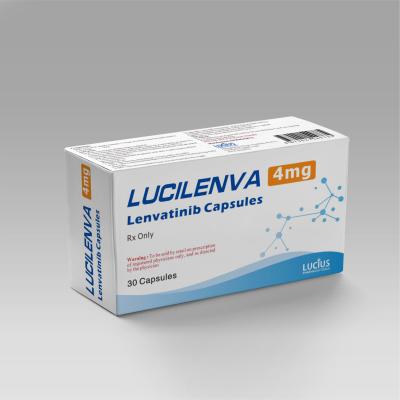
HIGHLIGHTS OF PRESCRIBING INFORMATION
These highlights do not include all the information needed to use LUCILENVA safely and effectively. See full prescribing information for LUCILENVA.
INDICATIONS AND USAGE
LUCILENVA is a kinase inhibitor that is indicated:
Differentiated Thyroid Cancer (DTC)
• For the treatment of patients with locally recurrent or metastatic, progressive, radioactive iodine-refractory differentiated thyroid cancer (DTC).
Renal Cell Carcinoma (RCC)
• In combination with pembrolizumab, for the first line treatment of adult patients with advanced renal cell carcinoma (RCC).
• In combination with everolimus, for the treatment of adult patients with advanced renal cell carcinoma (RCC) following one prior anti angiogenic therapy.
Hepatocellular Carcinoma (HCC)
• For the first-line treatment of patients with unresectable hepatocellular carcinoma (HCC).
Endometrial Carcinoma (EC)
• In combination with pembrolizumab, for the treatment of patients with advanced endometrial carcinoma (EC) that is mismatch repair proficient (pMMR), as determined by an FDA-approved test, or not microsatellite instability-high (MSI-H), who have disease progression following prior systemic therapy in any setting and are not candidates for curative surgery or radiation.
DOSAGE AND ADMINISTRATION
Single Agent Therapy:
• DTC: The recommended dosage is 24 mg orally once daily.
• HCC: The recommended dosage is based on actual body weight: 12 mg orally once daily for patients greater than or equal to 60 kg or 8 mg orally once daily for patients less than 60 kg.
Combination Therapy:
• EC: The recommended dosage is 20 mg orally once daily in combination with pembrolizumab 200 mg administered as an intravenous infusion over 30 minutes every 3 weeks.
• RCC: The recommended dosage is:
o 20 mg orally once daily with pembrolizumab 200 mg administered as an intravenous infusion over 30 minutes every 3 weeks.
o 18 mg orally once daily with everolimus 5 mg orally once daily.
Modify the recommended daily dose for certain patients with renal or hepatic impairment.
DOSAGE FORMS AND STRENGTHS
Capsules: 4 mg×30 capsules
CONTRAINDICATIONS
None.
WARNINGS AND PRECAUTIONS
• Hypertension: Control blood pressure prior to treatment and monitor during treatment. Withhold for Grade 3 hypertension despite optimal antihypertensive therapy. Discontinue for Grade 4 hypertension.
• Cardiac Dysfunction: Monitor for clinical symptoms or signs of cardiac dysfunction. Withhold or discontinue for Grade 3 cardiac dysfunction. Discontinue for Grade 4 cardiac dysfunction.
• Arterial Thromboembolic Events: Discontinue following an arterial thromboembolic event.
• Hepatotoxicity: Monitor liver function prior to treatment and periodically during treatment. Withhold or discontinue for Grade 3 or 4 hepatotoxicity. Discontinue for hepatic failure.
• Renal Failure or Impairment: Withhold or discontinue for Grade 3 or 4 renal failure or impairment.
• Proteinuria: Monitor for proteinuria prior to treatment and periodically during treatment. Withhold for 2 or more grams of proteinuria per 24 hours. Discontinue for nephrotic syndrome.
• Diarrhea: May be severe and recurrent. Promptly initiate management for severe diarrhea. Withhold or discontinue based on severity.
• Fistula Formation and Gastrointestinal Perforation: Discontinue in patients who develop Grade 3 or 4 fistula or any Grade gastrointestinal perforation.
• QT Interval Prolongation: Monitor and correct electrolyte abnormalities. Withhold for QT interval greater than 500 ms or for 60 ms or greater increase in baseline QT interval.
• Hypocalcemia: Monitor blood calcium levels at least monthly and replace calcium as necessary. Withhold or discontinue based on severity.
• Reversible Posterior Leukoencephalopathy Syndrome (RPLS): Withhold for RPLS until fully resolved or discontinue.
• Hemorrhagic Events: Withhold or discontinue based on severity.
• Impairment of Thyroid Stimulating Hormone Suppression/Thyroid Dysfunction: Monitor thyroid function prior to treatment and monthly during treatment.
• Impaired Wound Healing: Withhold LUCILENVA for at least 1 week before elective surgery. Do not administer for at least 2 weeks following major surgery and until adequate wound healing. The safety of resumption of LUCILENVA after resolution of wound healing complications has not been established.
• Osteonecrosis of the Jaw: Consider preventive dentistry prior to treatment with LUCILENVA. Avoid invasive dental procedures, if possible, particularly in patients at higher risk.
• Embryo-Fetal Toxicity: Can cause fetal harm. Advise females of reproductive potential of the potential risk to a fetus and to use effective contraception.
ADVERSE REACTIONS
• In DTC, the most common adverse reactions (incidence ≥30%) for LUCILENVA are hypertension, fatigue, diarrhea, arthralgia/myalgia, decreased appetite, decreased weight, nausea, stomatitis, headache, vomiting, proteinuria, palmar-plantar erythrodysesthesia syndrome, abdominal pain, and dysphonia.
• In RCC:
o The most common adverse reactions (incidence ≥20%) for LUCILENVA and pembrolizumab are fatigue, diarrhea, musculoskeletal pain, hypothyroidism, hypertension, stomatitis, decreased appetite, rash, nausea, decreased weight, dysphonia, proteinuria, palmar-plantar erythrodysesthesia syndrome, abdominal pain, hemorrhagic events, vomiting, constipation, hepatotoxicity, headache, and acute kidney injury.
o The most common adverse reactions (incidence ≥30%) for LUCILENVA and everolimus are diarrhea, fatigue, arthralgia/myalgia, decreased appetite, vomiting, nausea, stomatitis/oral inflammation, hypertension, peripheral edema, cough, abdominal pain, dyspnea, rash, decreased weight, hemorrhagic events, and proteinuria.
• In HCC, the most common adverse reactions (incidence ≥20%) for LUCILENVA are hypertension, fatigue, diarrhea, decreased appetite, arthralgia/myalgia, decreased weight, abdominal pain, palmar-plantar erythrodysesthesia syndrome, proteinuria, dysphonia, hemorrhagic events, hypothyroidism, and nausea.
• In EC, the most common adverse reactions (incidence ≥20%) for LUCILENVA and pembrolizumab are hypothyroidism, hypertension, fatigue, diarrhea, musculoskeletal disorders, nausea, decreased appetite, vomiting, stomatitis, decreased weight, abdominal pain, urinary tract infection, proteinuria, constipation, headache, hemorrhagic events, palmar-plantar erythrodysesthesia, dysphonia, and rash.
USE IN SPECIFIC POPULATIONS
• Lactation: Advise not to breastfeed.
Storage
Store at 20℃ to 25℃ (68℉ to 77℉), excursions permitted between 15℃ and 30℃ (59℉ and 86℉) [see USP Controlled Room Temperature]. Protect from moisture.
 WeChat
 WhatsApp