HIGHLIGHTS OF PRESCRIBING INFORMATION
These highlights do not include all the information needed to use LUCIVIGA safely and effectively. See full prescribing information for LUCIVIGA.
INDICATIONS AND USAGE
LUCIVIGAis indicated for the treatment of:
· Refractory Complex Partial Seizures as adjunctive therapy in patients 2 years of age and older who have responded inadequately to several alternative treatments; LUCIVIGA is not indicated as a first line agent.
· Infantile Spasms- monotherapy in infants 1 month to 2 years of age for whom the potential benefits outweigh the potential risk of vision loss.
DOSAGE AND ADMINISTRATION
Refractory Complex Partial Seizures
· Adults (17 years of age and older): Initiate at 1000 mg/day (500 mg twice daily); increase total daily dose weekly in 500 mg/day increments, to the recommended dose of 3000 mg/day (1500 mg twice daily).
· Pediatric (2 to 16 years of age): The recommended dosage is based on body weight and administered as two divided doses .
· The dosage may be increased in weekly intervals, depending on response.
· Dose patients weighing more than 60 kg according to adult recommendations .
Infantile Spasms
· Initiate at a daily dose of 50 mg/kg (25 mg/kg twice daily); increase total daily dose every 3 days, in increments of 25 mg/kg/day to 50 mg/kg/day, up to a maximum daily dose of 150 mg/kg (75 mg/kg twice daily) (2.3) Renal Impairment: Dose adjustment recommended.
DOSAGE FORMS AND STRENGTHS
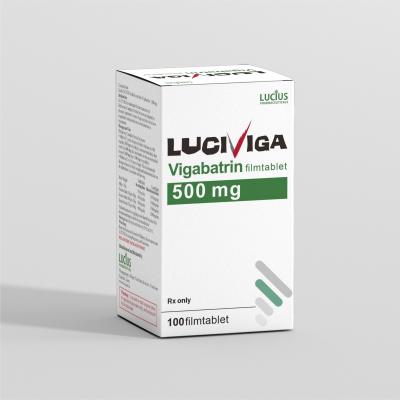
Tablets: 500 mg×100 tablets
CONTRAINDICATIONS
None.
WARNINGS AND PRECAUTIONS
· AbnormalMRIsignalchanges and intramyelinic edema have been reported in some infants with Infantile Spasms receiving LUCIVIGA.
· Suicidal behavior and ideation: Antiepileptic drugs, including LUCIVIGA, increase the risk of suicidal thoughts and behavior.
· Withdrawal of AEDs: Taper dose to avoid withdrawal seizures.
· Anemia: Monitor for symptoms of anemia.
· Somnolence and fatigue: Advise patients not to drive or operate machinery until they have gained sufficient experience on LUCIVIGA.
ADVERSE REACTIONS
Refractory Complex Partial Seizures
Most common adverse reactions in controlled studies include (incidence ≥5% over placebo):
· Adults: blurred vision, somnolence, dizziness, abnormal coordination, tremor, and fatigue (6.1)
· Pediatric patients (3 to 16 years of age): weight gain (6.1) Infantile Spasms (incidence >5% and greater than on placebo)
· Somnolence, bronchitis, ear infection, and acute otitis media.
DRUG INTERACTIONS
Decreased phenytoin plasma levels: dosage adjustment may be needed.
USE IN SPECIFIC POPULATIONS
· Pregnancy: Based on animal data, may cause fetal harm.
· Lactation: LUCIVIGA is excreted in human milk.
Storage
Store at 20℃ to 25℃ (68℉ to 77℉), excursions permitted between 15℃ and 30℃ (59℉ and 86℉) [see USP Controlled Room Temperature]. Protect from moisture.
 WeChat
 WhatsApp