HIGHLIGHTS OF PRESCRIBING INFORMATION
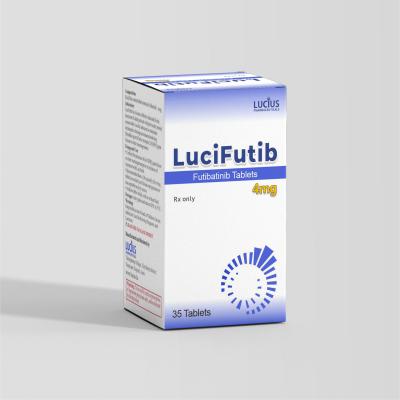
These highlights do not include all the information needed to use LuciFutib safely and effectively. See full prescribing information for LuciFutib.
INDICATIONS AND USAGE
LuciFutib is a kinase inhibitor indicated for the treatment of adult patients with previously treated, unresectable, locally advanced or metastatic intrahepatic cholangiocarcinoma harboring fibroblast growth factor receptor 2 (FGFR2) gene fusions or other rearrangements.
DOSAGE AND ADMINISTRATION
• Confirm the presence of an FGFR2 gene fusion or other rearrangement prior to initiation of treatment with LuciFutib.
• Recommended dose is 20 mg orally (five 4 mg tablets) once daily until disease progression or unacceptable toxicity occurs.
• Swallow tablet whole, with or without food.
DOSAGE FORMS AND STRENGTHS
Tablets: 4 mg×35 tablets
CONTRAINDICATIONS
None.
WARNINGS AND PRECAUTIONS
• Ocular Toxicity: LuciFutib can cause retinal pigment epithelial detachment (RPED). Perform a comprehensive ophthalmological examination including optical coherence tomography (OCT) prior to initiation of therapy, every 2 months for the first 6 months, and every 3 months thereafter and urgently at any time for visual symptoms.
• Hyperphosphatemia and Soft Tissue Mineralization: Increases in phosphate levels can cause hyperphosphatemia leading to soft tissue mineralization, calcinosis, nonuremic calciphylaxis and vascular calcification. Monitor for hyperphosphatemia and withhold, reduce the dose, or permanently discontinue based on duration and severity of hyperphosphatemia.
• Embryo-Fetal Toxicity: Can cause fetal harm. Advise patients of reproductive potential of the potential risk to the fetus and to use effective contraception.
ADVERSE REACTIONS
• Most common (≥20%) adverse reactions were nail toxicity, musculoskeletal pain, constipation, diarrhea, fatigue, dry mouth, alopecia, stomatitis, abdominal pain, dry skin, arthralgia, dysgeusia, dry eye, nausea, decreased appetite, urinary tract infection, palmar-plantar erythrodysesthesia syndrome, and vomiting.
• Most common laboratory abnormalities (≥20%) were increased phosphate, increased creatinine, decreased hemoglobin, increased glucose, increased calcium, decreased sodium, decreased phosphate, increased alanine aminotransferase, increased alkaline phosphatase, decreased lymphocytes, increased aspartate aminotransferase, decreased platelets, increased activated partial thromboplastin time, decreased leukocytes, decreased albumin, decreased neutrophils, increased creatine kinase, increased bilirubin, decreased glucose, increased prothrombin international normalized ratio, and decreased potassium.
DRUG INTERACTIONS
• Dual P-gp and strong CYP3A inhibitors: Avoid coadministration.
• Dual P-gp and strong CYP3A inducers: Avoid coadministration.
USE IN SPECIFIC POPULATIONS
• Lactation: Advise not to breastfeed.
Storage
Store at 20℃ to 25℃ (68℉ to 77℉), excursions permitted between 15℃ and 30℃ (59℉ and 86℉) [see USP Controlled Room Temperature]. Protect from moisture.
 WeChat
 WhatsApp