HIGHLIGHTS OF PRESCRIBING INFORMATION
These highlights do not include all the information needed to use LuciAva safely and effectively. See full prescribing information for LuciAva.
INDICATIONS AND USAGE
LuciAva is a kinase inhibitor indicated for:
Gastrointestinal Stromal Tumor (GIST)
• the treatment of adults with unresectable or metastatic GIST harboring a platelet-derived growth factor receptor alpha (PDGFRA) exon 18 mutation, including PDGFRA D842V mutations.
Advanced Systemic Mastocytosis (AdvSM).
• the treatment of adult patients with AdvSM. AdvSM includes patients with aggressive systemic mastocytosis (ASM), systemic mastocytosis with an associated hematological neoplasm (SMAHN), and mast cell leukemia (MCL).
• Limitations of Use: LuciAva is not recommended for the treatment of patients with AdvSM with platelet counts of less than 50×109/L
Indolent Systemic Mastocytosis (ISM)
• the treatment of adult patients with ISM.
• Limitations of Use: LuciAva is not recommended for the treatment of patients with ISM with platelet counts of less than 50×109/L.
DOSAGE AND ADMINISTRATION
• GIST: Select patients for treatment with LuciAva based on the presence of a PDGFRA exon 18 mutation.
• GIST: The recommended dosage is 300 mg orally once daily.
• AdvSM: The recommended dosage is 200 mg orally once daily.
• ISM: The recommended dosage is 25 mg orally once daily.
• Patients with severe hepatic impairment (Child-Pugh Class C): reduce dose of LuciAva.
DOSAGE FORMS AND STRENGTHS
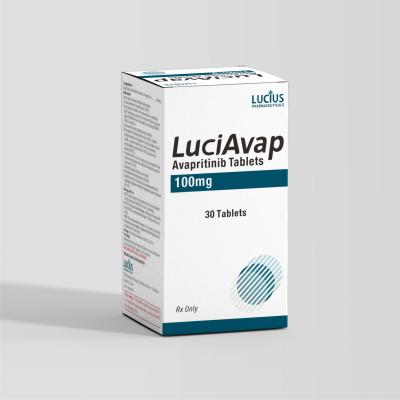
Tablets: 100 mg×30 tablets
CONTRAINDICATIONS
None.
WARNINGS AND PRECAUTIONS
• Intracranial Hemorrhage: Permanently discontinue for any occurrence of any grade.
• Cognitive Effects: A broad spectrum of cognitive adverse reactions can occur in patients receiving LuciAva. In patients with GIST, AdvSM, or ISM depending on the severity, continue LuciAva at same dose, withhold and then resume at same or reduced dose upon improvement, or permanently discontinue.
• Photosensitivity: May cause photosensitivity reactions. Advise patients to limit direct ultraviolet exposure.
• Embryo-Fetal Toxicity: Can cause fetal harm. Advise females and males of reproductive potential of the potential risk to a fetus and to use effective contraception.
ADVERSE REACTIONS
The most common adverse reactions are:
• GIST (≥20% incidence): edema, nausea, fatigue/asthenia, cognitive impairment, vomiting, decreased appetite, diarrhea, increased lacrimation, abdominal pain, constipation, rash, dizziness, and hair color changes.
• AdvSM (≥20% incidence): edema, diarrhea, nausea, and fatigue/asthenia.
• ISM (≥10% incidence): eye edema, dizziness, peripheral edema and flushing.
DRUG INTERACTIONS
• Strong and Moderate CYP3A Inhibitors: Avoid coadministration of LuciAva with strong and moderate CYP3A inhibitors. If coadministration of LuciAva with a moderate inhibitor cannot be avoided, reduce dose of LuciAva in patients with GIST or AdvSM.
• Strong and Moderate CYP3A Inducers: Avoid coadministration of LuciAva with strong and moderate CYP3A inducers.
USE IN SPECIFIC POPULATIONS
Lactation: Advise not to breastfeed.
Storage
Store at 20℃ to 25℃ (68℉ to 77℉), excursions permitted between 15℃ and 30℃ (59℉ and 86℉) [see USP Controlled Room Temperature]. Protect from moisture.
 WeChat
 WhatsApp