HIGHLIGHTS OF PRESCRIBING INFORMATION
These highlights do not include all the information needed to use LUCISETA safely and effectively. See full prescribing information for LUCISETA.
INDICATIONS AND USAGE
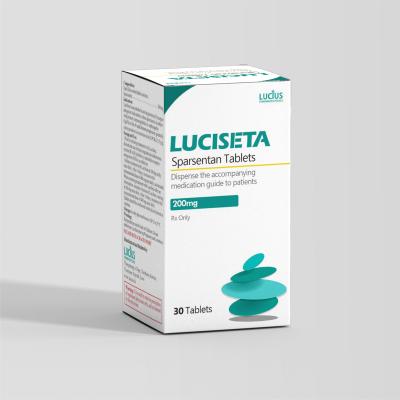
LUCISETA is an endothelin and angiotensin II receptor antagonist indicated to reduce proteinuria in adults with primary immunoglobulin A nephropathy (IgAN) at risk of rapid disease progression, generally a urine protein-to-creatinine ratio (UPCR) ≥1.5 g/g.
This indication is approved under accelerated approval based on reduction of proteinuria. It has not been established whether LUCISETA slows kidney function decline in patients with IgAN. Continued approval for this indication may be contingent upon verification and description of clinical benefit in a confirmatory clinical trial.
DOSAGE AND ADMINISTRATION
• Prior to initiating treatment with LUCISETA, discontinue use of renin-angiotensin-aldosterone system (RAAS) inhibitors, endothelin receptor antagonists (ERAs) or aliskiren .
• Initiate treatment with LUCISETA at 200 mg orally once daily. After 14 days, increase to the recommended dose of 400 mg once daily, as tolerated. When resuming treatment with LUCISETA after an interruption, consider titration of LUCISETA, starting at 200 mg once daily. After 14 days, increase to the recommended dose of 400 mg once daily.
• Instruct patients to swallow tablets whole with water prior to the morning or evening meal .
DOSAGE FORMS AND STRENGTHS
Tablets: 200 mg×30 tablets
CONTRAINDICATIONS
• Pregnancy (4).
• Do not coadminister LUCISETA with angiotensin receptor blockers, endothelin receptor antagonists, or aliskiren .
WARNINGS AND PRECAUTIONS
• Hepatotoxicity
• Embryo-Fetal Toxicity
• Hypotension
• Acute Kidney Injury
• Hyperkalemia
• Fluid Retention
ADVERSE REACTIONS
Most common adverse reactions (≥5%) are peripheral edema, hypotension (including orthostatic hypotension), dizziness, hyperkalemia, and anemia.
DRUG INTERACTIONS
• Renin-Angiotensin System (RAS) inhibitors and ERAs: Contraindicated. Increased risk of hypotension, hyperkalemia.
• Strong CYP3A inhibitors: Avoid concomitant use. Increased sparsentan exposure.
• Moderate CYP3A inhibitors: Monitor adverse reactions. Increased sparsentan exposure.
• Strong CYP3A inducers: Avoid concomitant use. Decreased sparsentan exposure.
• Antacids: Avoid use within 2 hours before or after use of sparsentan. May decrease exposure to sparsentan.
• Acid reducing agents: Avoid concomitant use. May decrease exposure to sparsentan.
• Nonsteroidal anti-inflammatory drugs (NSAIDs) including selective cyclooxygenase (COX-2) inhibitors: Monitor for signs of worsening renal function. Increased risk of kidney injury.
• CYP2B6, 2C9, and 2C19 substrates: Monitor for efficacy of the concurrently administered substrates. Decreased exposure of these substrates.
• Sensitive P-gp and BCRP substrates: Avoid concomitant use. Increased exposure to substrates.
• Agents Increasing Serum Potassium: Increased risk of hyperkalemia, monitor serum potassium frequently.
USE IN SPECIFIC POPULATIONS
Lactation: Advise not to breastfeed.
Storage
Store at 20℃ to 25℃ (68℉ to 77℉), excursions permitted between 15℃ and 30℃ (59℉ and 86℉) [see USP Controlled Room Temperature]. Protect from moisture.
 WeChat
 WhatsApp