HIGHLIGHTS OF PRESCRIBING INFORMATION
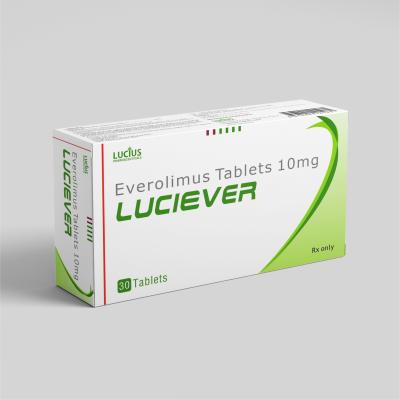
These highlights do not include all the information needed to use LuciEver safely and effectively. See full prescribing information for LuciEver.
INDICATIONS AND USAGE
LuciEver is a kinase inhibitor indicated for the treatment of:
• Postmenopausal women with advanced hormone receptor-positive, HER2 negative breast cancer in combination with exemestane after failure of treatment with letrozole or anastrozole.
• Adults with progressive neuroendocrine tumors of pancreatic origin (PNET) and adults with progressive, well-differentiated, non-functional neuroendocrine tumors (NET) of gastrointestinal (GI) or lung origin that are unresectable, locally advanced or metastatic.
Limitations of Use: LuciEver is not indicated for the treatment of patients with functional carcinoid tumors.
• Adults with advanced renal cell carcinoma (RCC) after failure of treatment with sunitinib or sorafenib.
• Adults with renal angiomyolipoma and tuberous sclerosis complex (TSC), not requiring immediate surgery.
LuciEver is a kinase inhibitors indicated for the treatment of adult and pediatric patients aged 1 year and older with TSC who have subependymal giant cell astrocytoma (SEGA) that requires therapeutic intervention but cannot be curatively resected.
DOSAGE AND ADMINISTRATION
Modify the dose for patients with hepatic impairment or for patients taking drugs that inhibit or induce P-glycoprotein (P-gp) and CYP3A4.
Breast Cancer:
• 10 mg orally once daily.
NET:
• 10 mg orally once daily.
RCC:
• 10 mg orally once daily.
TSC-Associated Renal Angiomyolipoma:
• 10 mg orally once daily.
TSC-Associated SEGA:
• 4.5 mg/m2 orally once daily; adjust dose to attain trough concentrations of 5-15 ng/mL.
TSC-Associated Partial-Onset Seizures:
• 5 mg/m2 orally once daily; adjust dose to attain trough concentrations of 5-15 ng/mL.
DOSAGE FORMS AND STRENGTHS
Tablets: 5mg×30 tablets/box、10mg×30 tablets/box
CONTRAINDICATIONS
Clinically significant hypersensitivity to everolimus or to other rapamycin derivatives.
WARNINGS AND PRECAUTIONS
· Non-Infectious Pneumonitis: Monitor for clinical symptoms or radiological changes. Withhold or permanently discontinue based on severity.
· Infections: Monitor for signs and symptoms of infection. Withhold or permanently discontinue based on severity.
· Severe Hypersensitivity Reactions: Permanently discontinue for clinically significant hypersensitivity.
· Angioedema: Patients taking concomitant angiotensin-converting-enzyme (ACE) inhibitors may be at increased risk for angioedema. Permanently discontinue for angioedema.
· Stomatitis: Initiate dexamethasone alcohol-free mouthwash when starting treatment.
· Renal Failure: Monitor renal function prior to treatment and periodically thereafter.
· Risk of Impaired Wound Healing: Withhold for at least 1 week prior to elective surgery. Do not administer for at least 2 weeks following major surgery and until adequate wound healing. The safety of resumption of treatment after resolution of wound healing complications has not been established.
· Geriatric Patients: Monitor and adjust dose for adverse reactions.
· Metabolic Disorders: Monitor serum glucose and lipids prior to treatment and periodically thereafter. Withhold or permanently discontinue based on severity.
· Myelosuppression: Monitor hematologic parameters prior to treatment and periodically thereafter. Withhold or permanently discontinue based on severity.
· Risk of Infection or Reduced Immune Response with Vaccination: Avoid live vaccines and close contact with those who have received live vaccines. Complete recommended childhood vaccinations prior to starting treatment.
· Radiation Sensitization and Radiation Recall: Severe radiation reactions may occur.
· Embryo-Fetal Toxicity: Can cause fetal harm. Advise patients of reproductive potential of the potential risk to a fetus and to use effective contraception.
ADVERSE REACTIONS
· Breast cancer, NET, RCC: Most common adverse reactions (incidence ≥ 30%) include stomatitis, infections, rash, fatigue, diarrhea, edema, abdominal pain, nausea, fever, asthenia, cough, headache, and decreased appetite.
· TSC-Associated Renal Angiomyolipoma: Most common adverse reaction (incidence ≥ 30%) is stomatitis.
· TSC-Associated SEGA: Most common adverse reactions (incidence ≥ 30%) are stomatitis and respiratory tract infection.
· TSC-Associated Partial-Onset Seizures: Most common adverse reaction (incidence ≥ 30%) is stomatitis.
DRUG INTERACTIONS
· P-gp and strong CYP3A4 inhibitors: Avoid concomitant use.
· P-gp and moderate CYP3A4 inhibitors: Reduce the dose as recommended.
· P-gp and strong CYP3A4 inducers: Increase the dose as recommended.
USE IN SPECIFIC POPULATIONS
· For breast cancer, NET, RCC, or TSC-associated renal angiomyolipoma patients with hepatic impairment, reduce the dose.
· For patients with TSC-associated SEGA or TSC-associated partial-onset seizures and severe hepatic impairment, reduce the starting dose and adjust dose to attain target trough concentrations.
Storage
Store at 20°C to 25°C (68°F to 77°F), excursions permitted between 15°C and 30°C (59°F and 86°F) [see USP Controlled Room Temperature]. Protect from moisture.
 WeChat
 WhatsApp