HIGHLIGHTS OF PRESCRIBING INFORMATION
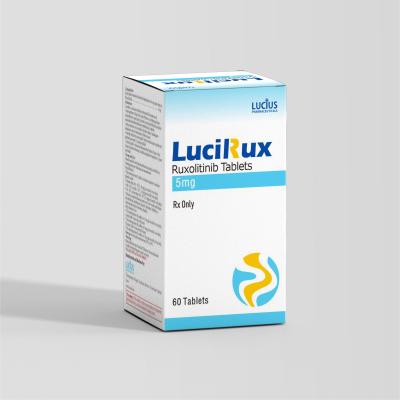
These highlights do not include all the information needed to use LuciRux safely and effectively. See full prescribing information for LuciRux.
INDICATIONS AND USAGE
Jakafi is a kinase inhibitor indicated for treatment of:
• intermediate or high-risk myelofibrosis, including primary myelofibrosis, post-polycythemia vera myelofibrosis and post-essential thrombocythemia myelofibrosis in adults.
• polycythemia vera in adults who have had an inadequate response to or are intolerant of hydroxyurea.
• steroid-refractory acute graft-versus-host disease in adult and pediatric patients 12 years and older.
• chronic graft-versus-host disease after failure of one or two lines of systemic therapy in adult and pediatric patients 12 years and older.
DOSAGE AND ADMINISTRATION
Doses should be individualized based on safety and efficacy. Starting doses per indication are noted below.
Myelofibrosis
• The starting dose of Jakafi is based on patient’s baseline platelet count:
• Greater than 200 × 109/L: 20 mg given orally twice daily
• 100 × 109/L to 200 × 109/L: 15 mg given orally twice daily
• 50 × 109/L to less than 100 × 109/L: 5 mg given orally twice daily
• Monitor complete blood counts every 2 to 4 weeks until doses are stabilized, and then as clinically indicated. Modify or interrupt dosing for thrombocytopenia.
Polycythemia Vera
• The starting dose of Jakafi is 10 mg given orally twice daily.
Acute Graft-Versus-Host Disease
• The starting dose of Jakafi is 5 mg given orally twice daily.
Chronic Graft-Versus-Host Disease
• The starting dose of Jakafi is 10 mg given orally twice daily.
DOSAGE FORMS AND STRENGTHS
Tablets: 5mg×60 tablets
CONTRAINDICATIONS
None
WARNINGS AND PRECAUTIONS
• Thrombocytopenia, Anemia and Neutropenia: Manage by dose reduction, or interruption, or transfusion.
• Risk of Infection: Assess patients for signs and symptoms of infection and initiate appropriate treatment promptly. Serious infections should have resolved before starting therapy with Jakafi.
• Symptom Exacerbation Following Interruption or Discontinuation: Manage with supportive care and consider resuming treatment with Jakafi.
• Risk of Non-Melanoma Skin Cancer: Perform periodic skin examinations.
• Lipid Elevations: Assess lipid levels 8-12 weeks from start of therapy and treat as needed.
• Major Adverse Cardiovascular Events (MACE): Monitor for development of MACE.
• Thrombosis: Evaluate and treat symptoms of thrombosis promptly.
• Secondary Malignancies: Monitor for development of secondary malignancies, particularly in patients who are current or past smokers.
ADVERSE REACTIONS
• In myelofibrosis and polycythemia vera, the most common hematologic adverse reactions (incidence > 20%) are thrombocytopenia and anemia. The most common nonhematologic adverse reactions (incidence ≥ 15%) are bruising, dizziness, headache, and diarrhea.
• In acute graft-versus-host disease, the most common hematologic adverse reactions (incidence > 50%) are anemia, thrombocytopenia, and neutropenia. The most common nonhematologic adverse reactions (incidence > 50%) are infections (pathogen not specified) and edema.
• In chronic graft-versus-host disease, the most common hematologic adverse reactions (incidence > 35%) are anemia and thrombocytopenia. The most common nonhematologic adverse reactions (incidence ≥ 20%) are infections (pathogen not specified) and viral infections.
DRUG INTERACTIONS
• Fluconazole: Avoid concomitant use with fluconazole doses greater than 200 mg. Reduce Jakafi dosage with fluconazole doses less than or equal to 200 mg.
• Strong CYP3A4 Inhibitors: Reduce, interrupt, or discontinue Jakafi doses as recommended except in patients with acute or chronic graftversus-host-disease.
USE IN SPECIFIC POPULATIONS
• Renal Impairment: Reduce Jakafi starting dose or avoid treatment as recommended.
• Hepatic Impairment: Reduce Jakafi starting dose or avoid treatment as recommended.
• Lactation: Advise not to breastfeed.
Storage
Store at 20°C to 25°C (68°F to 77°F), excursions permitted between 15°C and 30°C (59°F and 86°F) [see USP Controlled Room Temperature]. Protect from moisture.
 WeChat
 WhatsApp