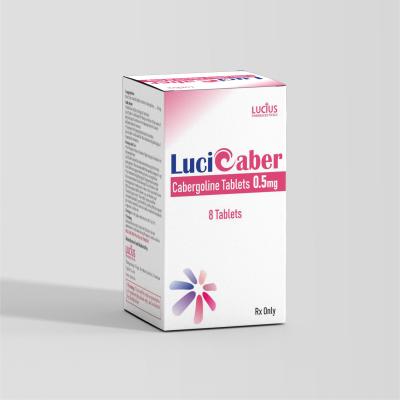
HIGHLIGHTS OF PRESCRIBING INFORMATION
These highlights do not include all the information needed to use LuciCaber safely and effectively. See full prescribing information for LuciCaber.
INDICATIONS AND USAGE
Inhibition of physiological lactation
LuciCaber is indicated for the prevention of the onset of physiological lactation in the puerperium for clearly defined medical reasons.
Treatment of hyperprolactinemic disorders
LuciCaber is indicated for the treatment of pathological hyperprolactinaemia.
DOSAGE AND ADMINISTRATION
Adults
For the prevention of onset of physiological lactation in the peurperium: LuciCaber should be administered during the first day post-partum. The recommended therapeutic dosage is 1 mg (two 500 microgram tablets) given as a single dose.
For treatment of pathological hyperprolactinaemia: the recommended initial dosage of LuciCaber is 500 microgram per week given in one or two (one-half of one 500 microgram tablet) doses (e.g. on Monday and Thursday) per week. The weekly dose should be increased gradually, preferably by adding 500 microgram per week at monthly intervals until an optimal therapeutic response is achieved. The therapeutic dosage is usually 1 mg per week and ranges from 250 microgram to 2 mg per week. Doses of LuciCaber up to 4.5 mg per week have been used in hyperprolactinaemic patients.
Children
The safety and efficacy of LuciCaber has not been established in subjects less than 16 years of age.
Elderly
Very limited data concerning experience of treatment of hyperprolactinaemia in the elderly are available. However, available data do not indicate a special risk for this population.
DOSAGE FORMS AND STRENGTHS
Tablets: 0.5 mg×8 tablets
CONTRAINDICATIONS
Hypersensitivity to cabergoline, other ergot alkaloids, or to any of the excipients.
History of pulmonary, pericardial and retroperitoneal fibrotic disorders.
Anatomical evidence of cardiac valvulopathy of any valve as determined by pre-treatment (e.g. echocardiogram showing valve leaflet thickening, valve restriction, valve mixed restriction stenosis).
WARNINGS AND PRECAUTIONS
As with other ergot derivatives, LuciCaber should be given with caution to patients with severe cardiovascular disease, Raynaud's syndrome, liver disease, renal insufficiency, peptic ulcer or gastrointestinal bleeding, or with a history of serious, particularly psychotic, mental disorders.
ADVERSE REACTIONS
In women treated for inhibition of physiological lactation the most frequently occurring adverse events are asymptomatic decreases in blood pressure, dizziness/vertigo, headache, nausea, somnolence and abdominal pain. In addition, on rare occasions palpitations, epigastric pain, epistaxis, transient hemianopia, vomiting, syncope, asthenia, and hot flushes have been reported.
Most side effects are transient and mild to moderate in severity.
In patients treated for hyperprolactinaemia, the most common symptoms in decreasing rank of frequency are nausea, headache, dizziness/vertigo, abdominal pain/dyspepsia/gastritis, asthenia/fatigue, constipation, vomiting, breast pain, hot flushes, depression and paraesthesia.
DRUG INTERACTIONS
The concomitant use of other drugs during early puerperium, particularly of methylergometrine maleate, has not been associated with detectable interactions modifying the efficacy and safety of LuciCaber.
Although there is no conclusive evidence of an interaction between LuciCaber and other ergot alkaloids, the concomitant use of these medications during long-term therapy with LuciCaber is not recommended.
Since LuciCaber exerts its therapeutic effect by direct stimulation of dopamine receptors, it should not be concurrently administered with drugs which have dopamine antagonist activity (such as phenothiazines, butyrophenones, thioxanthenes, metoclopramide) since these might reduce the PRL-lowering effect of LuciCaber.
Mono-oxygenase activity was increased 1.5 to 3 fold in female rats treated with cabergoline 100 microgram/kg/day to 1.5 mg/kg/day orally. Concomitant administration of cabergoline with drugs metabolised by mono-oxygenases may result in altered exposure and activity.
LuciCaber should not be used with macrolide antibiotics (e.g. erythromycin) due to increased systemic bioavailability of cabergoline.
USE IN SPECIFIC POPULATIONS
Use in lactation
LuciCaber should not be administered to mothers who elect to breast feed their infants, since it prevents lactation and no information on the excretion of the compound in maternal milk in humans is available. For the same reason, puerperal women should not breast-feed in case of failed lactation inhibition/ suppression by LuciCaber.
Use in pregnancy - Category B1
Before LuciCaber administration, pregnancy should be excluded and after treatment pregnancy should be prevented for at least one month.
Storage
Store at 20℃ to 25℃ (68℉ to 77℉), excursions permitted between 15℃ and 30℃ (59℉ and 86℉) [see USP Controlled Room Temperature]. Protect from moisture.
 WeChat
 WhatsApp