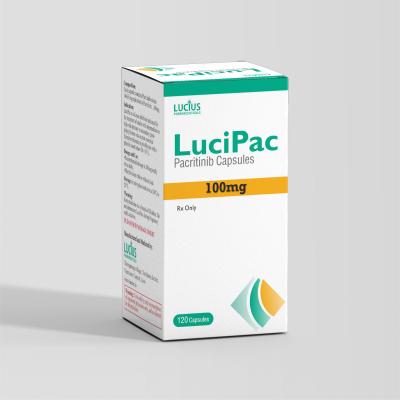
HIGHLIGHTS OF PRESCRIBING INFORMATION
These highlights do not include all the information needed to use LuciPac safely and effectively. See full prescribing information for LuciPac.
INDICATIONS AND USAGE
LuciPac is a kinase inhibitor indicated for the treatment of adults with intermediate or high-risk primary or secondary (post-polycythemia vera or post-essential thrombocythemia) myelofibrosis with a platelet count below 50×109/L .
This indication is approved under accelerated approval based on spleen volume reduction. Continued approval for this indication may be contingent upon verification and description of clinical benefit in a confirmatory trial(s).
DOSAGE AND ADMINISTRATION
• Recommended dosage is 200 mg orally twice daily.
• May be taken with or without food.
DOSAGE FORMS AND STRENGTHS
Capsules: 100 mg×120 capsules
CONTRAINDICATIONS
Concomitant use of strong CYP3A4 inhibitors or inducers.
WARNINGS AND PRECAUTIONS
• Hemorrhage: Avoid use in patients with active bleeding and hold LuciPac prior to any planned surgical procedures. May require dose interruption, dose reduction or permanent discontinuation depending on severity.
• Diarrhea: Manage significant diarrhea with anti-diarrheals, dose reduction, or dose interruption.
• Thrombocytopenia: Manage by dose reduction or interruption.
• Prolonged QT Interval: Avoid use in patients with baseline QTc >480 msec. Interrupt and reduce LuciPac dosage in patients who have a QTcF >500 msec. Correct hypokalemia prior to and during LuciPac administration.
• Major Adverse Cardiac Events (MACE): Risk may be increased in current/past smokers and patients with other cardiovascular risk factors. Monitor for signs, evaluate and treat promptly.
• Thrombosis: Including deep venous thrombosis, pulmonary embolism, and arterial thrombosis may occur. Monitor for signs, evaluate and treat promptly.
• Secondary Malignancies: Lymphoma and other malignancies may occur. Past/current smokers may be at increased risk.
• Risk of Infection: Delay starting LuciPac until active serious infections have resolved. Observe for signs and symptoms of infection and manage promptly.
ADVERSE REACTIONS
The most common (≥20% of patients) adverse reactions are diarrhea, thrombocytopenia, nausea, anemia, and peripheral edema.
DRUG INTERACTIONS
Avoid use with moderate CYP3A4 inhibitors or inducers.
Coadministration of LuciPac can alter the concentration of drugs that are Pgp, BCRP, or OCT1 substrates. Avoid use with sensitive substrates.
USE IN SPECIFIC POPULATIONS
Lactation: Advise not to breastfeed.
Hepatic Impairment: Avoid use in moderate (Child-Pugh B) and severe hepatic impairment (Child-Pugh C) .
Renal Impairment: Avoid use in patients with eGFR<30 mL/min.
Storage
Store at 20℃ to 25℃ (68℉ to 77℉), excursions permitted between 15℃ and 30℃ (59℉ and 86℉) [see USP Controlled Room Temperature]. Protect from moisture.
 WeChat
 WhatsApp