HIGHLIGHTS OF PRESCRIBING INFORMATION
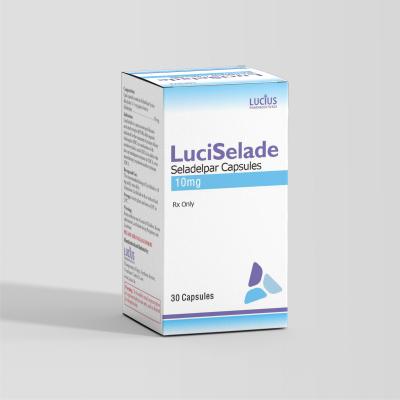
These highlights do not include all the information needed to use LuciSelade safely and effectively. See full prescribing information for LuciSelade.
INDICATIONS AND USAGE
LuciSelade is a peroxisome proliferator-activated receptor (PPAR)-delta agonist indicated for the treatment of primary biliary cholangitis (PBC) in combination with ursodeoxycholic acid (UDCA) in adults who have an inadequate response to UDCA, or as monotherapy in patients unable to tolerate UDCA.
This indication is approved under accelerated approval based on a reduction of alkaline phosphatase (ALP). Improvement in survival or prevention of liver decompensation events have not been demonstrated. Continued approval for this indication may be contingent upon verification and description of clinical benefit in confirmatory trial(s).
Limitations of Use
Use of LuciSelade is not recommended in patients who have or develop decompensated cirrhosis (e.g., ascites, variceal bleeding, hepatic encephalopathy).
DOSAGE AND ADMINISTRATION
The recommended dosage of LuciSelade is 10 mg orally once daily.
Administer LuciSelade with or without food.
DOSAGE FORMS AND STRENGTHS
Capsules: 10 mg×30 capsules
CONTRAINDICATIONS
None
WARNINGS AND PRECAUTIONS
• Fractures: Consider the risk of fracture in patients treated with LuciSelade. Monitor bone health according to current standards of care.
• Liver Test Abnormalities: Obtain baseline clinical and laboratory liver assessments prior to starting LuciSelade and monitor during treatment. Interrupt or discontinue LuciSelade if the liver tests worsen.
• Biliary Obstruction: Avoid use in patients with complete biliary obstruction. If biliary obstruction is suspected, interrupt LuciSelade and treat as clinically indicated.
ADVERSE REACTIONS
Most common adverse reactions (reported in ≥5% and higher compared to placebo) are headache, abdominal pain, nausea, abdominal distension, and dizziness.
DRUG INTERACTIONS
• OAT3 Inhibitors: Avoid concomitant use.
• Strong CYP2C9 Inhibitors: Avoid concomitant use.
• Rifampin: Monitor biochemical response (e.g., ALP and bilirubin) when patients initiate rifampin.
• Dual Moderate CYP2C9 and Moderate to Strong CYP3A4 Inhibitors: Monitor closely for adverse effects.
• CYP2C9 Poor Metabolizers using Moderate to Strong CYP3A4 Inhibitors: Monitor more frequently for adverse effects.
• BCRP Inhibitors: Monitor closely for adverse effects.
• Bile Acid Sequestrants: Administer at least 4 hours before or 4 hours after taking a bile acid sequestrant, or at as great an interval as possible.
USE IN SPECIFIC POPULATIONS
Hepatic Impairment: Monitor patients with cirrhosis for evidence of decompensation. Consider discontinuation if patient progresses to moderate or severe hepatic impairment (Child-Pugh B or C).
Storage
Store at 20°C to 25°C (68°F to 77°F), excursions permitted between 15°C and 30°C (59°F and 86°F) [see USP Controlled Room Temperature]. Protect from moisture.
 WeChat
 WhatsApp