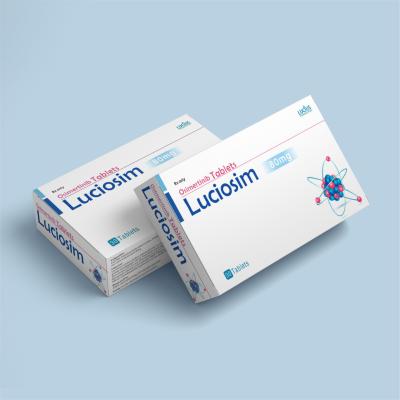
HIGHLIGHTS OF PRESCRIBING INFORMATION
These highlights do not include all the information needed to use LuciOsim safely and effectively. See full prescribing information for LuciOsim.
INDICATIONS AND USAGE
LuciOsim is a kinase inhibitor indicated for:
• as adjuvant therapy after tumor resection in adult patients with non-small cell lung cancer (NSCLC) whose tumors have epidermal growth factor receptor (EGFR) exon 19 deletions or exon 21 L858R mutations, as detected by an FDA-approved test.
• the first-line treatment of adult patients with metastatic NSCLC whose tumors have EGFR exon 19 deletions or exon 21 L858R mutations, as detected by an FDA-approved test.
• the treatment of adult patients with metastatic EGFR T790M mutation-positive NSCLC, as detected by an FDA-approved test, whose disease has progressed on or after EGFR TKI therapy.
DOSAGE AND ADMINISTRATION
Adjuvant treatment of early-stage NSCLC: 80 mg orally once daily, with or without food, until disease recurrence, or unacceptable toxicity, or for up to 3 years.
Metastatic NSCLC: 80 mg orally once daily, with or without food, until disease progression or unacceptable toxicity.
DOSAGE FORMS AND STRENGTHS
Tablets: 80 mg×30 tablets
CONTRAINDICATIONS
None.
WARNINGS AND PRECAUTIONS
• Interstitial Lung Disease (ILD)/Pneumonitis: Occurred in 3.8% of patients. Permanently discontinue LuciOsim in patients diagnosed with ILD/Pneumonitis.
• QTc Interval Prolongation: Monitor electrocardiograms and electrolytes in patients who have a history or predisposition for QTc prolongation, or those who are taking medications that are known to prolong the QTc interval. Withhold then restart at a reduced dose or permanently discontinue LuciOsim.
• Cardiomyopathy: Occurred in 3% of patients. Conduct cardiac monitoring, including left ventricular ejection fraction (LVEF) assessment in patients with cardiac risk factors.
• Keratitis: Promptly refer patients with signs and symptoms of keratitis to an ophthalmologist for evaluation.
• Erythema Multiforme Major, Stevens-Johnson Syndrome, and Toxic Epidermal Necrolysis: Withhold LuciOsim if erythema multiforme major (EMM), StevensJohnson syndrome (SJS), or toxic epidermal necrolysis (TEN) is suspected and permanently discontinue if confirmed.
• Cutaneous Vasculitis: Withhold LuciOsim if cutaneous vasculitis is suspected, evaluate for systemic involvement, and consider dermatology consultation. If no other etiology can be identified, consider permanent discontinuation based on severity.
• Aplastic Anemia: Withhold LuciOsim if aplastic anemia is suspected and permanently discontinue LuciOsim if confirmed.
• Embryo-Fetal Toxicity: LuciOsim can cause fetal harm. Advise females of potential risk to the fetus and to use effective contraception during treatment with LuciOsim and for 6 weeks after final dose. Advise males to use effective contraception for 4 months, after the last dose of LuciOsim.
ADVERSE REACTIONS
Most common (>20%) adverse reactions, including laboratory abnormalities were leukopenia, lymphopenia, thrombocytopenia, diarrhea, anemia, rash, musculoskeletal pain, nail toxicity, neutropenia, dry skin, stomatitis, fatigue, and cough.
DRUG INTERACTIONS
Strong CYP3A Inducers: Avoid if possible. If not possible, increase LuciOsim to 160 mg daily in patients receiving a strong CYP3A4 inducer.
USE IN SPECIFIC POPULATIONS
Lactation: Do not breastfeed.
Storage
Store at 20℃ to 25℃ (68℉ to 77℉), excursions permitted between 15℃ and 30℃ (59℉ and 86℉) [see USP Controlled Room Temperature]. Protect from moisture.
 WeChat
 WhatsApp